
Grundig and Telefunken: what they ship with and what comes off
· 8 min read
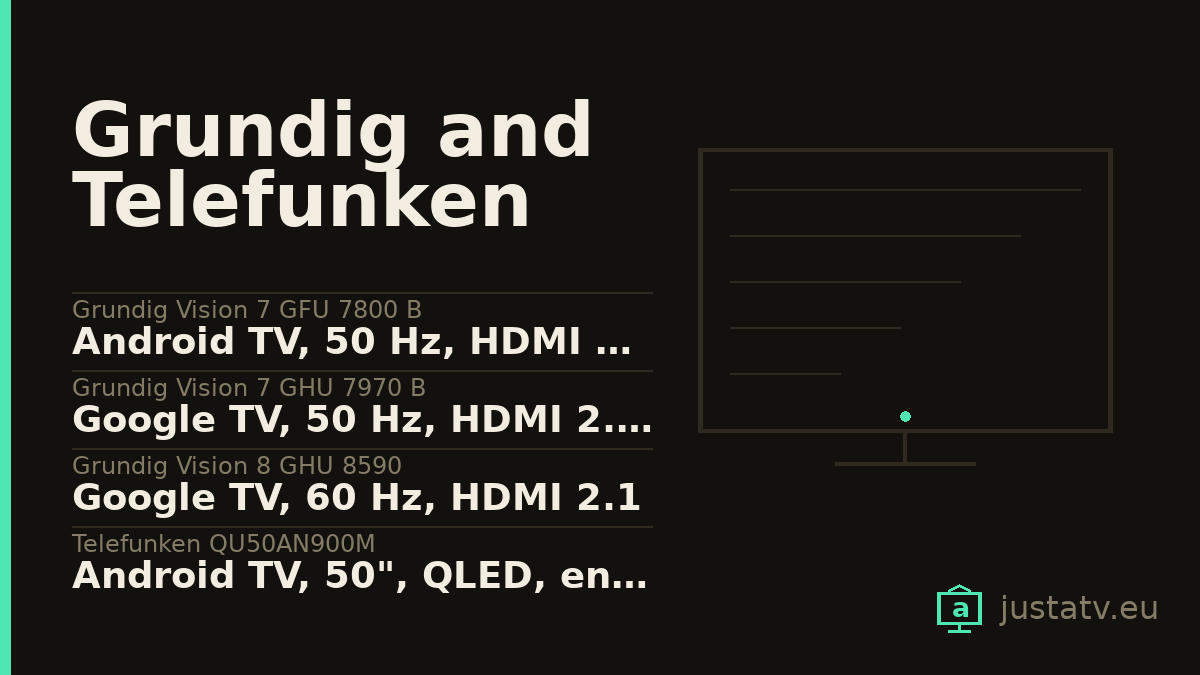
| Grundig Vision 7 GFU 7800 B | Android TV, 50 Hz, HDMI 2.0 |
|---|---|
| Grundig Vision 7 GHU 7970 B | Google TV, 50 Hz, HDMI 2.1 with eARC |
| Grundig Vision 8 GHU 8590 | Google TV, 60 Hz, HDMI 2.1 |
| Telefunken QU50AN900M | Android TV, 50", QLED, energy class E |
| Telefunken XU50TO750S | TiVo OS: not Android, no ADB |
| Resolution | 4K UHD, 3840 × 2160, on all of them |
| Grundig manufacturer | Arctic S.A., Găești, Romania |
| Telefunken manufacturer | Vestel, the brand's licensee |
| Memory | Neither brand publishes RAM or storage |
| Brightness | Neither brand publishes any nits figure |
| Updates | 8 years declared on the GHU 7970 B EPREL sheet |
Two brands with German surnames, both of them sold in quantity in Spain and in Germany, and both of them hard to research for opposite reasons. Grundig publishes plenty and contradicts itself. Telefunken publishes almost nothing, because Telefunken does not build televisions.
Let us start there, because that is what saves time.
Telefunken is not a manufacturer: it is a rented name
The brand's own site says so plainly. It states that «at the start of the new millennium came the strategic shift to a licence brand», and that ever since, the products are made by «selected independent companies acting on their own responsibility (brand licensees)».
That has a practical consequence: the Telefunken set in a Spanish shop and the one in a German shop may have nothing in common, because there can be different companies behind them.
In Telefunken's own service-partner finder, if you pick televisions («TV-Sets») the contact it returns for Spain, Germany, France, Italy, Portugal and Austria is the same one: Vestel Holland B.V., German branch office, in Garching. Vestel is a Turkish manufacturer. This is not a deduction: it is what their site answers.
Two more details worth knowing. telefunken.es is not a Spanish site: it
returns a 301 to telefunken.com, which is in German. And
vestel-germany.de, the service site the brand itself gives as the
contact, had on 30 August 2026 a TLS certificate that expired on 28
February, and it redirects to Vestel's corporate site, where there are no
manuals.
The two Telefunken sets that are actually published
That German site lists exactly two televisions, both 50-inch and both 3840 × 2160:
- QU50AN900M, «50-Zoll QLED Android TV». Energy class E, RRP €499.99. The page says Android TV in as many words: «Android TV, the television's modern operating system».
- XU50TO750S, «50-Zoll 4K-UHD TiVo Smart TV». Class F, RRP €429.99. It runs TiVo OS, which is not Android.
And two things do not add up on that same page. The TiVo model's sheet says «Display: QLED», yet its own buying links point at a product described as LED. And the Android one says «Diagonale: 132 cm (50 Zoll)»: 50 inches are 127 centimetres, and its own buying links say 126 cm.
On memory, brightness, panel refresh rate or Android version, nothing.
If yours is the TiVo model, this guide does not apply. TiVo OS is not
Android: there is no ADB, no packages to disable and no df. It is the
same situation as VIDAA or Tizen.
Grundig: a German brand that sells no televisions in Germany
Grundig belongs to Beko today (its own site says «our parent company, Beko») and its televisions are built by Arctic S.A., in Găești, Romania, according to each model's European product information sheet.
That has changed. Since 1 January 2026 the name is licensed to China's Changhong outside Türkiye, and it is Arçelik's own 2025 integrated report that says so. The full quote is in the Grundig and Beko sheet.
The striking part is where they live. On grundig.com/de-de, the German
site, there is not a single mention of televisions: the categories are
kitchen, laundry, home care and personal care. The television catalogue
sits on the Spanish site, and it dates from 2022 and 2023.
Which system each line runs
Grundig does publish this, model by model, in the «Operating system» field:
- Vision 7 GFU 7800 B (43", 50", 55") and GFU 7960 B (55"): Android TV. A 50 Hz panel, three HDMI 2.0, HDR without Dolby Vision, 2 × 8 W of sound (2 × 10 W on the 7960 B).
- Vision 7 GHU 7970 B (43", 50", 55", 65", 75"): Google TV. 50 Hz, three HDMI 2.1 with eARC, Dolby Vision and HDR10+, MEMC, 2 × 10 W (2 × 15 W on the 75-inch).
- Vision 8 GHU 8590 (55", 65"): Google TV, and the only one with a 60 Hz panel.
In other words, the letter that matters is the third one. GFU is Android TV; GHU is Google TV. And apart from the 8590 line, they are all 50 Hz panels, which the European energy sheet confirms, not just the website.

What changes between Android TV and Google TV
The cleaning method is the same, but the names are not.
The launcher. On Google TV it is com.google.android.tvlauncher; on
Android TV it is com.google.android.leanbacklauncher. Without it, the
television boots to a black screen. Any list copied off the internet that
mentions one of the two is useless for the other.
The menus. Grundig's manual is explicit for each case. On the GHU sets, with Google TV, it is Settings → System → About and Settings → System → Storage. On the GFU sets, with Android TV, it is Settings → Device preferences → About and Settings → Device preferences → Storage. If you follow a guide written for the other one, that is where you get lost.
If you would rather not go menu-hunting:
adb shell pm list packages | grep launcher tells you in one line.
The memory: the figure that decides how many years it lasts
Neither Grundig nor Telefunken publishes RAM or storage. Not on any sheet, not for any line. And on an entry-level television that is precisely what decides how long it holds up: once the storage fills, apps stop updating and eventually the set cannot apply its own system update.
Grundig's official manual goes as far as showing the storage screen with the blank left unfilled: «Total space: xx GB».
The good news is that, being Android, you can find out yourself. With ADB connected:
df -h /data tells you how much there is and how much is left.
cat /proc/meminfo | head -1 gives you the total memory.
If you have under two gigabytes free, cleaning up stops being optional.
What Grundig does publish and almost nobody reads
Each model's European product information sheet carries real figures. The 55 GHU 7970 B declares 77.6 W on-mode in SDR, 115 W in HDR, 0.50 W in standby and 2.0 W in networked standby. The 65 GHU 8590, 100 W and 155 W. The 75 GHU 7970 B, 107 W and 195 W.
And a figure almost no manufacturer highlights: that same sheet declares 8 years of minimum guaranteed availability of software and firmware updates on the GHU sets, and 7 years on the 55 GFU 7800B. Seven years of spare parts and of product support on both.
Watch the energy class, because the site contradicts itself: the header of every product page shows «Energy class - SDR: A» and dimensions of 0 × 0 × 0 cm, identical across all ten models. The table on the same page says F or G, and the European sheet confirms it. The table wins.
What they ship with
The Google part. The launcher, the services
(com.google.android.gms), voice search (com.google.android.katniss)
and, on the Google TV sets, the recommendations engine
(com.google.android.tvrecommendations).
The brand's part. Very little. Grundig adds the setup assistant and its picture and sound layer; the rest of the software is Google's.
Third parties. Netflix, Prime Video and company, by commercial agreement.
What comes off, and what does not
Streaming apps you do not use come off without much thought, and so do the free-content channels that fill the home screen. On a television whose memory you do not know until you measure it, each one is room you might need.
Before touching any package, go through Settings → Privacy: Location, Usage and diagnostics and Ads live there, along with the advertising ID reset. A fair amount can be trimmed from there, with no ADB and no risk.
You do not touch Google Play services, nor the launcher while you have no
other one working, nor anything starting with com.android. without
knowing what it is: com.android.systemui is the interface and
com.android.settings is the settings app itself.
What you notice and what you do not
You notice the recovered space, a home screen without services you have not subscribed to, and less background activity. What does not change is the panel's 50 Hz, the HDMI 2.0 on the GFU sets, or the brightness, which nobody publishes either.
All of this is reversible: disabled packages come back with one command, and a factory reset returns the set to the state it left the box in.
If you own one
Both brands are missing exactly the same thing: the output of
df -h /data and of cat /proc/meminfo, and which launcher shows up in
pm list packages. For the Telefunken QU50AN900M there is not a single
published figure on memory, panel or Android version, so there any answer
from somebody who owns one is worth more than the official sheet.