
TCL Q6C and Q7C: what they ship with and what can come off
· 8 min read
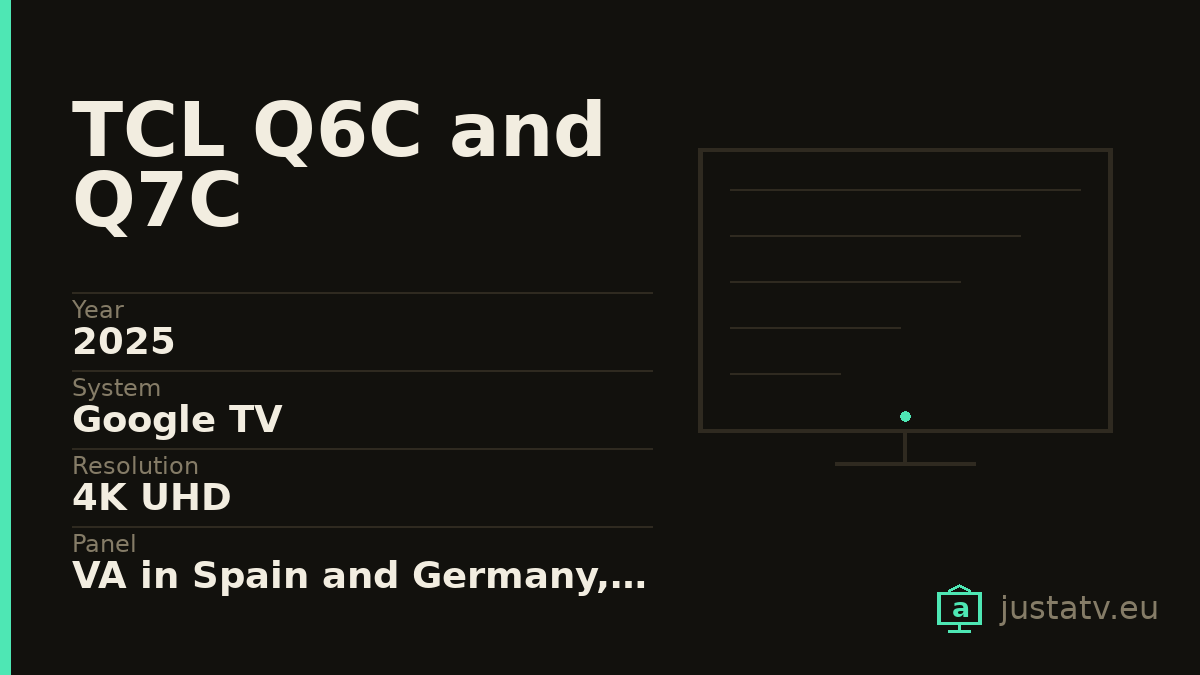
| Year | 2025 |
|---|---|
| System | Google TV |
| Resolution | 4K UHD |
| Panel | VA in Spain and Germany, LED in the UK, QLED LCD in the regulated sheet |
| Refresh rate | 144 Hz on the website, 120 Hz in the European fiche |
| Dimming zones | "Up to" 512 on the Q6C and "up to" 2,048 on the Q7C |
| Brightness | 2,000 to 3,000 nits on the Q7C; the Q6C publishes no figure |
| Colour | 93 % DCI-P3 the Q6C; 97 % the Q7C except the 115" |
| HDR | Dolby Vision IQ, HDR10+ and HLG on both |
| Sound | Onkyo 2.1 of 40 W on the Q6C; Bang & Olufsen with no watts on the Q7C |
| Memory | TCL publishes neither RAM nor storage on either |
| Connections | 4 × HDMI 2.1 with eARC on port 1, according to the British sheet |
| Updates | 8 years declared in the European regulated fiche |
| Sizes | 50" to 98"; the Q7C reaches 115" in Spain only |
The Q6C and the Q7C are the two QD-Mini LED sets with which TCL covers the middle of its European catalogue. They are alive in Spain, the UK and Germany, they run from 50 to 98 inches, both carry Google TV and both announce a "144 Hz native refresh rate" on the first line of their page.
And both have a problem this article is going to look at squarely: their official spec sheet does not say the same thing depending on the country you read it in.
One television, three sheets that disagree
This is not an impression. These are the specification tables on tcl.com for the same model, downloaded on the same day in all three countries.
The panel type of the 65Q7C is VA in Spain and Germany, and LED in the
UK. The audio power of that same 65Q7C is / in Spain and Germany, that
is to say nothing, and 60 W with a 6.2.2 B&O system in the UK. The HDMI
ports are not counted in Spain or Germany (there you only get the versions,
HDMI1.4 & HDMI2.0 & HDMI2.1), while the British sheet says 4 x 2.1 and
even names the eARC port: eARC HDMI 1.
The clearest case is the 50 inch Q7C. The Spanish and German pages say
HDR 2000 nits and DTS Virtual:X. The British one, for the same 50Q7C, says
HDR 3000 nits and Audio by BANG & OLUFSEN. A thousand nits of difference
and a sound brand that appears or vanishes with the flag in the corner.
The German sheet is also the thinnest: it publishes no audio power, no colour gamut and no brightness for the Q6C.
The 144 Hz, and the document that says 120
Both announce 144 Hz native in the header bullets. Their own table, two
screenfuls further down, says MEMC 120HZ; VRR 48HZ~288Hz; DLG 240Hz. And the
product information sheet required by European regulation 2019/2013, the one
for 65Q7CX1, says in field 20: "Image refresh frequency (default):
120 Hz".
All three can be true at once: the panel accepts 144 Hz over HDMI, DLG doubles lines up to 240 at 1080p, and the regulated document declares the default mode. But the headline figure is not the one TCL signs before the European Commission.
The same goes for the panel: the website says Mini LED and HVA, and the
regulated fiche says QLED LCD. It is an LCD with Mini LED backlighting, and
the three labels describe different parts of the same set.
The zones: "up to" is not "has"
The Q7C announces a "Precise Dimming Series up to 2,048 zones" and the Q6C "up to 512". The word that matters is up to, and it is on all six sizes of each series: the 50 inch page and the 98 inch page carry exactly the same figure.
So the number belongs to the series, not to your television, and TCL nowhere publishes how many zones each size has. The only one that breaks the pattern is the 115Q7C, sold in Spain alone, which rises to "up to 2,880 zones".
Brightness works much the same, and here there are numbers. The Q7C declares 2,000 nits at 50 inches, 2,600 at 55 and 65, and 3,000 from 75 upwards. The Q6C declares none: its brightness field reads "High HDR Brightness" in all three versions of the sheet. It is a numeric field filled in with an adjective.
What the regulated fiche does say
Here is the good part, and it is not on tcl.com. The European fiche for the Q6C and the Q7C declares eight years of minimum guaranteed availability of software and firmware updates, eight years of spare parts and eight of product support, plus a two year warranty. Eight years is at the top of the market, and TCL does not advertise it on any country's product page.
It also settles the energy classes, which the website gets wrong. The 85Q6C
shows as D in Spain and as F in Germany; the fiche for 85Q6CX2 says
D, with 103 W in SDR and 390 in HDR. The 75Q6C shows as F in both Spain and
Germany, and its fiche (75Q6CX2) says E, with 107 and 238 W. And the
115Q7C, which the Spanish page sells with a full spec table, has no EPREL
record at all under that identifier.
The supplier signing all of them is TCL Operations Polska Sp. z o.o., of Żyrardów, Poland.
What nobody publishes
Neither RAM nor storage. Across the three national sheets, both series and all six sizes, the field does not exist. That is the figure that decides how many years the set will last you: once storage fills up, apps stop updating and eventually the television cannot apply its own update.
The Android version. It says "Google TV" and stops there.
How many HDMI ports there are, unless you read the British sheet.
You can find all of that out yourself. With ADB connected, df -h /data gives
you the storage and cat /proc/meminfo | head -1 the total memory. The HDMI
ports are counted by looking at the back.

Where they really differ
The Q7C has more colour (97 % of DCI-P3 against the Q6C's 93 %), four times
the declared zones and Bang & Olufsen sound. The Q6C has Onkyo 2.1 and does
publish its watts: 2×10W+20W, that is 40 W with a bass driver.
Both share Google TV, Dolby Vision IQ, HDR10+, HLG, Dolby Atmos, an AiPQ Pro processor, Wi-Fi 5, Bluetooth 5.4, FreeSync and eARC. The only set in either series with Wi-Fi 6 is the 115Q7C.
How to tell whether this article is about your set
Under Settings → System → About you get the model and the Android version.
With ADB, getprop ro.product.model gives the same without any menus.
Mind the name: on the web it is 65Q7C, in the European fiche it is
65Q7CX1, and in the UK the same television is called 65Q7C-UK and
registered as 65Q7C-UKX7. Same machine, commercial suffix.
What it ships with
The Google part. The launcher (com.google.android.tvlauncher), the
recommendation engine (com.google.android.tvrecommendations), voice search
(com.google.android.katniss) and the services (com.google.android.gms).
The TCL part. Its channel apps, TCL Home and a setup assistant or two. A note belongs here: in the official Google Play device list, TCL has twenty television platforms and all twenty are its own, shared with nobody. Of the 439 television brands in that file, 401 have not a single one. Which means the firmware in a Q6C is maintained by TCL, not by a board maker it buys the design from.
The third party part. Netflix, Prime Video, Disney+ and company arrive by commercial agreement, not because the television needs them.
What comes off without much thought
The streaming apps you do not use. On a set whose storage you do not know until you look, each one is room you may need. If you subscribe tomorrow, it reinstalls from the store in two minutes.
The free content channels that fill the home screen are the second clear case.
What to think about first
The recommendation engine. Removing it leaves the home screen clean, but it also empties the "continue watching" row, which is missed in a household with several people.
And before touching any package, go into the privacy settings and look at what the television is sharing. A fair amount can be cut back from there, no ADB needed.
What not to touch
Google Play services. Without them the television boots and little else.
The launcher, as long as you have no other one installed and working. A television with no launcher comes on to a black screen, and fixing that with only the remote is much harder than having thought about it first.
Anything starting with com.android. that you cannot identify:
com.android.systemui is the system interface and com.android.settings is
the settings app itself.
What you actually notice
The home screen stops pushing shows from services you do not have, content notifications disappear, and the set answers the remote a little sooner after switching on.
What does not change: the zones, the nits, the HDR or the sound. None of that lives in the apps; it lives in the firmware underneath Google TV.
All of this is reversible
Packages disabled over ADB come back with one command, and a factory reset returns the television to the state it left the box in. Nothing here touches the system.
If you own one
What these two need is what their maker will not say: how many zones your
particular size has, and the output of df -h /data and of
cat /proc/meminfo. With two or three answers, this article will finally be
able to state how much memory a Q6C carries, which today nobody states.