
Tesla and Vivax: what they ship with and what comes off
· 7 min read
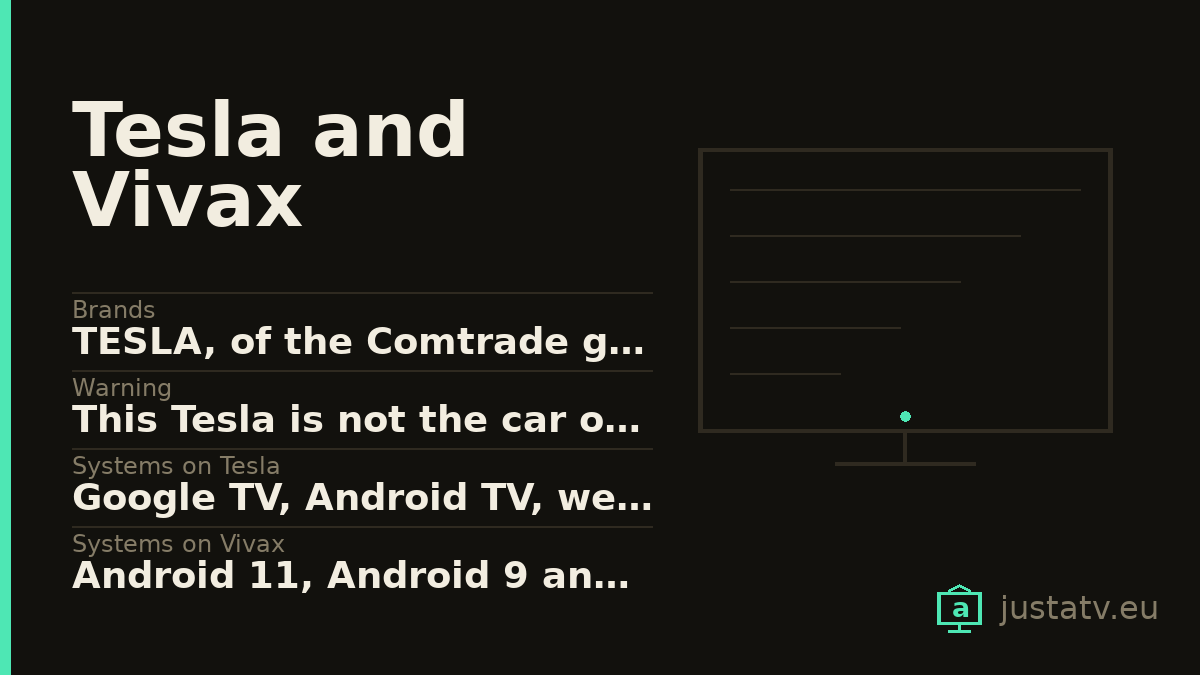
| Brands | TESLA, of the Comtrade group; VIVAX, of M SAN Grupa |
|---|---|
| Warning | This Tesla is not the car one |
| Systems on Tesla | Google TV, Android TV, webOS, VIDAA, Linux and none |
| Systems on Vivax | Android 11, Android 9 and webOS Hub |
| Directory entries | 12 platforms for Tesla, 4 for Vivax |
| Exclusive platforms | None at all, on either brand |
| Lowest RAM published | 1 GB, on 25 Tesla Android models |
| Memory on Vivax | Published for 17 of its 34 smart televisions |
| Source | EPREL, brand websites and the Google Play device list |
Let us clear up the obvious first, because it is the first thing you will
think: the Tesla in this article has nothing to do with the cars. It is a
Balkan consumer electronics brand. Its own page says so plainly: «Tesla is a
consumer electronics brand under the Comtrade Distribution, founded in
2014». The group is Comtrade, of Belgrade, and the footer of tesla.info
signs off with «© Comtrade Group 2026». The name comes from Nikola Tesla,
who was Serbian. That is all.
Vivax is the other brand you find in every shop in the region. Behind it is M SAN Grupa d.o.o., of Dugoselska ulica 5, Rugvica, Croatia, tax number 34695138237, entered in the Zagreb commercial register. The brand says it was born in 2004 and sells in 42 countries.
We downloaded both catalogues in full, their 183 PDF specification sheets, their European register entries and the Google Play device directory. Things turn up that neither of them tells you in the shop.
Neither has hardware of its own
In the official Google Play device list, Tesla shows up with 21 television
entries spread over 12 platforms, and not one is its own: yeongdeungpo is
shared with 49 brands, zhongshan with 48, martin with 46, dongnae with
45, tamachi with 44. Sharp, Thomson, JVC, Blaupunkt, Grundig and
Continental Edison live in those same neighbourhoods.
Vivax has five entries across four platforms, and none of those is its
own either: elliniko (58 brands), longshan (52), stanford (52) and
zhongshan (48). It shares elliniko with Philips and with
Kivi,
and longshan with Nokia and CHiQ.
None of that is unusual: of the 439 television brands in the directory,
401 (91 %) have no platform of their own. What does stand out is the
detail. One of the Vivax entries carries AI PONT as its model name, the
reference design used by 109 different brands. And the marketing name
field for Tesla on martin reads EU、UK、AP, ideographic Chinese comma and
all: the form was filled in by the maker, not by the brand.
Six operating systems at once
Tesla currently sells 158 television models on its website. Its own «Smart OS» field declares six different things: 40 with Google TV, 34 with Android TV, 26 with webOS, 26 with VIDAA, 7 with Linux and 25 with no smart system at all.
Which means the brand name tells you nothing about the machine. The Q65E655GUS runs Google TV and the Q65E665BUV, one letter apart, runs VIDAA. Series 9 is Google TV, Series 6 can be either, and Series 3 has no system.
Vivax is simpler: of its 56 televisions, 34 are smart and 22 are not. Of those 34, 13 run Android 11, 11 run Android 9.0 and 9 run webOS Hub, the licensed version of LG's system.
It matters because it changes the launcher name:
com.google.android.leanbacklauncher is the old Android TV interface;
com.google.android.tvlauncher is the Google TV one. And because none of
what follows works on the webOS and VIDAA sets: there is no ADB there.
Memory, which is the figure that decides the years
In this bracket what decides how long a television lasts is not the panel: it is the memory. Once storage fills up, apps stop updating and in the end the set cannot even apply its own system update.
Tesla does publish the memory, and you have to go looking for it. It is
not in the web spec table: it is in the PDF sheet, in a row called
RAM/Storage. We downloaded all 136 that exist and 98 carry it.
The hard figure: of the 66 Android or Google TV models with a sheet, 25 declare 1 GB of RAM. All of them are 24, 32, 40 or 43 inches, and they include models from this very year, such as the 32E655BHS or the Q43E665GFS. Among the affordable Spanish brands, 1.5 GB of RAM and 8 GB of storage is the floor, and TD Systems and Nevir publish it model by model. Those 25 Tesla sets are below the floor.
Higher up, storage is generous: the E655 sets from 43 inches upward declare 2 GB / 64 GB, and the O949 reaches 3 GB / 32 GB. Nine of those sheets also carry a note worth reading in full: «*Models produced before 2026 have 16 GB of internal memory». That is, the same model number ships with 16 or 64 gigabytes depending on the year it was built.
The ones that publish nothing are all 13 VIDAA models, plus the Q85E969GUS, which is the flagship.
Vivax publishes the RAM of 17 of its 34 smart televisions, exactly half,
and says nothing on the web about the nine webOS Hub ones. Its PDFs do
though: the eight we found all read 1,5/8GB, and the TV-43S60WO reads
1/8GB. Compare that with Kivi, which publishes storage for all 67 of its
models and RAM for only 17, seven of them with 1 GB.
And there is a contradiction worth knowing about: on the A Series
65UHD10K and the 75UHD10K, the web page says «2 GB radne (RAM)
memorije» and the specification PDF says Memory: 1/8GB. Both files are
Vivax's own.

Look for yourself, because here you can
The good thing about this being Android is that you do not depend on the sheet. With ADB connected:
df -h /data tells you how much storage there is and how much is free.
cat /proc/meminfo | head -1 tells you the total memory.
If you have less than two gigabytes free, the clean-up this site explains
stops being optional. And if /proc/meminfo comes back with something close
to one gigabyte, you now know why it is slow. On an E655 bought this year,
df -h /data is also the only way to find out whether you got the 16
gigabytes or the 64.
What they declare in the European register
In EPREL the two brands behave in opposite ways.
Tesla declares 196 registrations and the pagination keeps returning the
same block of 25: we managed to pull 46 unique entries out of seven
requests, and we are not going to extrapolate. In those 46 the registrant
is Comtrade Distribucija d.o.o. and it appears as
AUTHORISED_REPRESENTATIVE in 42 of them, that is, authorised
representative and not manufacturer. The software update years field is
blank in 18, says two years in 15, three in 6 and eight in 7. The contact
service is ITS d.o.o., of Ljubljana.
Vivax declares 27 and we pulled 25. All 25 are in the name of M SAN
Grupa d.o.o., all 25 register as MANUFACTURER, all 25 declare eight
years of software updates, two of warranty and seven of spare parts. Not
one blank field.
With an awkward twist: the Vivax website files all 56 of its televisions under the heading «Televizori - End of Life», even though its most recent registrations date from May 2025.
What comes off and what stays
The Google side. The launcher, the recommendation engine
(com.google.android.tvrecommendations), voice search
(com.google.android.katniss) and the services
(com.google.android.gms).
Third parties. Netflix, Prime Video and the rest are there by commercial deal. Remove the ones you do not use: with 8 GB, each one is space you are going to need.
Carefully, the recommendation engine: it leaves the screen clean but empties the «continue watching» row.
Leave alone: Google Play services, the launcher while you have no other
one working, and anything starting with com.android. that you cannot
identify.
All of this is reversible: disabled packages come back with one command, and a factory reset leaves the television as it came out of the box. The method is the same as for the rest of the own-brand range.
If you own one
From these two brands one thing above all is useful: the output of
cat /proc/meminfo | head -1 and of df -h /data. With a few answers we can
say what the Tesla VIDAA sets really carry, which nobody publishes, and
whether this year's E655 ships with 16 or 64 gigabytes.