
Kivi and Strong: what they ship with and what comes off
· 7 min read
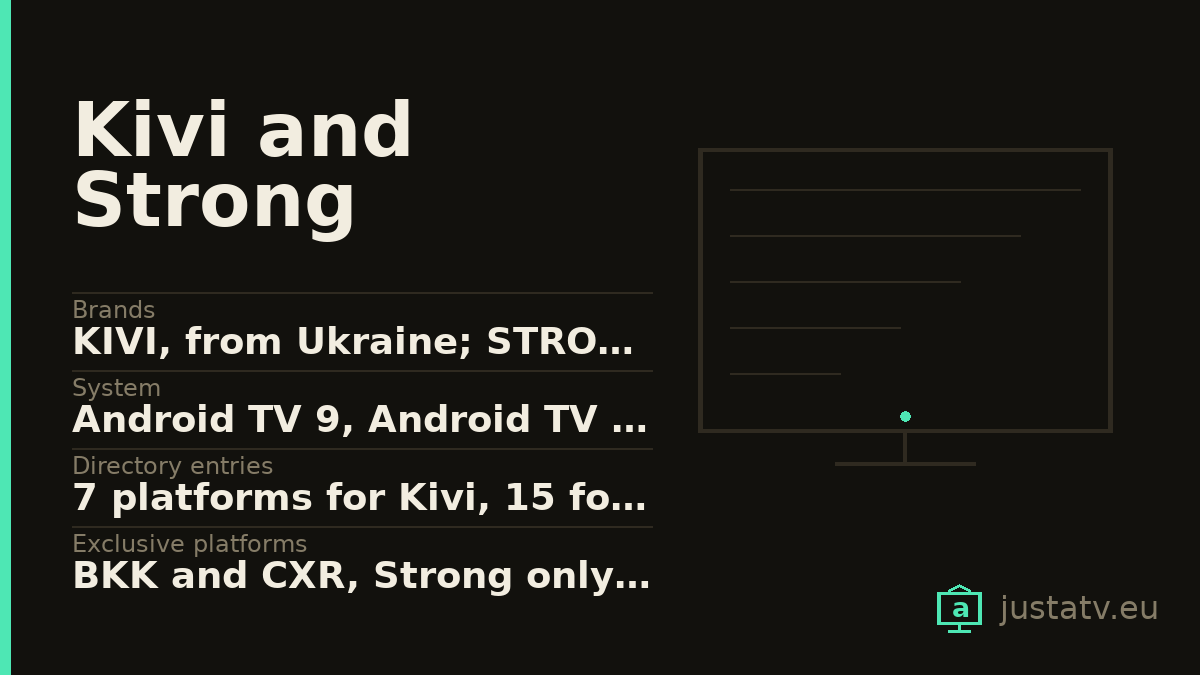
| Brands | KIVI, from Ukraine; STRONG, part of the Skyworth group |
|---|---|
| System | Android TV 9, Android TV 11 or Google TV depending on the series |
| Directory entries | 7 platforms for Kivi, 15 for Strong |
| Exclusive platforms | BKK and CXR, Strong only, and both are sticks |
| Storage on Kivi | 8 GB across all 67 smart models |
| RAM on Kivi | Published for 17 of 67; the floor is 1 GB |
| Memory on Strong | On the sticks yes; on the televisions, never |
| Source | EPREL, brand websites and the Google Play device list |
Kivi and Strong turn up on every list of cheap European televisions, and almost nobody has looked inside. We downloaded both catalogues in full, their European register entries and the Google Play device directory. What comes out is not what either brand tells you.
Start with the silly part: neither one is where you would look for it.
kivi.tv answers, and it is a US company selling connected TV advertising
to Hispanic audiences. kivi.eu serves the site of a Slovenian IT
consultancy. And strong.tv resolves but never opens the connection. The
real sites are kivismart.com and strong-eu.com.
Who is behind each one
KIVI tells its own story plainly. It started in 2016 by signing a deal with Shenzhen MTC, one of the big contract television manufacturers; in 2021 it took 13 million dollars from Shenzhen MTC for product development. The sound was developed with JVC Kenwood and the remotes with Remote Solution. It presents itself as a European brand, the office is in Ukraine and the factory is Chinese.
The party answering in Europe is yet another company: the 25 EPREL records
we could download are all filed by KIVI SMART PURCHASING Kft., Fehérvári
út 50-52, Budapest, with the address [email protected].
STRONG says it on its own page: "STRONG Group, a Skyworth company". Skyworth Digital bought the business in 2015. The website is published by STRONG S.A.R.L, of Boulogne-Billancourt, registered in Nanterre under number B 481 612 455. But in EPREL the records are filed by STRONG Ges.m.b.H., Teinfaltstraße 8, Vienna, with a French contact phone. French on the outside, Austrian in the register, Chinese at the top.
Strong's two own platforms, and what they are
In the official Google Play device list, Kivi has seven platforms
(bangbae, bruno, elliniko, komagome, osaka, stanford and
zhongshan) and none of them is its own: it shares elliniko with 58
brands, osaka with 54, stanford with 52.
Strong has fifteen, and two are exclusive: BKK and CXR. That is
unusual. Almost every television entry in this bracket carries the model
name AI PONT, a reference design used by 109 brands in the directory,
and of those 109 only five have any platform of their own: Strong,
JVC,
CHiQ, Haier and BenQ.
Here we do know what they are, because the directory says so in its
marketing name field: BKK is the LEAP-UNA+ and CXR is the
LEAP-NOVA. Both exist on strong-eu.com under exactly those names, and
both are HDMI sticks, not televisions. That fits: Skyworth builds
set-top boxes and players, and that is where Strong puts its own hardware.
Its televisions sit on osaka, alimos, longshan, redwood, bangbae
and komagome, the same crowded own-brand neighbourhoods as everyone else.
Memory, which is what decides the years
In this bracket, what decides how long a television lasts is not the panel: it is the memory. Once the storage fills up, apps stop updating and in the end the set cannot even apply its own system update.
KIVI does something almost nobody does: it publishes the storage. We walked all 75 product pages in its catalogue (two are broken links that return 404) and of the 73 good ones, 67 declare a smart system and all 67 say 8 GB. Without a single exception.
RAM is another matter: it appears on only 17 of those 67. And where it does, there is an awkward number. Seven models declare 1 GB of RAM, all running Android TV 9: the 24H740LB, 24H740LW, 32H740LB, 32H740LW, 32F740LB, 40F740LB and 32F790LW. Seven more declare 1.5 GB and three declare 2 GB.
The contrast matters. Among the Spanish budget brands, 1.5 GB of RAM and 8 GB of storage is the floor, and TD Systems and Nevir publish it model by model. Those seven Kivi sets are below the floor. And CHiQ, with a large catalogue, publishes the memory of exactly one television: Kivi publishes the storage of all 67.
STRONG does the opposite, on the same website. Its eight streaming devices declare the memory one by one: the LEAP-UNA+, LEAP-UNA, LEAP-NEVE and SRT41 carry 8 GB; the LEAP-NOVA and LEAP-S3PRO, 32 GB; the LEAP-S4, 64 GB. For the LEAP-UNA+ they even name the processor, a Realtek RTD1332.
About its televisions they say nothing. No RAM, no storage, no processor, on any of the thirteen pages we read. The same brand that itemises the memory of a thirty-euro stick goes quiet about the four-hundred-euro TV.

Look for yourself, because here you can
The good thing about this being Android is that you do not depend on any spec sheet. With ADB connected:
df -h /data tells you how much storage there is and how much is free.
cat /proc/meminfo | head -1 tells you the total memory.
If you have less than two gigabytes free, the cleanup this site explains
stops being optional. And if /proc/meminfo comes back near one gigabyte,
you now know why it feels slow.
Which system each model runs
Neither brand orders this in any intuitive way.
On Kivi, the 710 and 720 series run Google TV, while the 730, 740, 750, 760 and 790 series, higher numbers and later on paper, run Android TV. On top of that, the 740 and the 750 mix Android TV 9 and Android TV 11 depending on the unit. The number does not tell you the system.
Strong is the same. The SRT32HD5553 and SRT32HH5553 are Android TV; the SRT24HI4723C, SRT32HG4723C, SRT40FG6733C and SRT43UH7773 are Google TV. The SRT32HH5553 and the SRT43UH7773 share a letter and run different systems. And two of them, the SRT24HE4023 and the SRT32HF2003, run neither.
It matters because it changes the name of the launcher:
com.google.android.leanbacklauncher is the older Android TV interface;
com.google.android.tvlauncher is the Google TV one.
What they declare in the European register
In EPREL, Kivi declares 42 records and returns the same 25 whichever page you ask for: 25 of 42 downloaded, and we are not extrapolating the rest. Across those 25: two years of guarantee on all of them, eight years of support on 23 and five years of software updates on 23. Two models, the 43F750NB and the 65U750NB, drop to three and three. None left blank, which in this directory is news in itself.
Strong declares 58, and three separate requests, overlapping but not identical, got us 23 of its own records. In those: two years of guarantee on 22, eight years of updates on 21, and the SRT 43UC6433 with all three fields empty. One warning: searching EPREL for "STRONG" also returns three records from MileStrong, an unrelated Chinese company.
One more thing worth knowing: Strong's PSTI compliance page and its four-year guarantee cover no television at all. They are networking products only.
What comes off and what stays
Google's own. The launcher, the recommendations engine
(com.google.android.tvrecommendations), the voice search
(com.google.android.katniss) and the services
(com.google.android.gms).
The brand's own. On Kivi, the KIVI MEDIA app, its free-channel store, preinstalled. On Strong, little more than a setup assistant.
Third parties. Netflix, Prime Video and the rest, by commercial deal. Remove the ones you do not use: with 8 GB, each one is space you will want.
Carefully, the recommendations engine: it leaves the home screen clean but empties the "continue watching" row.
Leave alone: Google Play services, the launcher for as long as you have
no other one working, and anything starting with com.android. that you
cannot identify.
All of this is reversible: disabled packages come back with one command and a factory reset leaves the set as it came out of the box. The method is the same as for the rest of the own-brand range.
If you own one
From these two brands we mostly need one thing: the output of
cat /proc/meminfo | head -1. Kivi publishes the RAM of 17 of its 67 models
and Strong of none of its televisions. With a handful of answers we could
say how much each series carries, which is exactly what nobody tells you
today.