
JVC, Blaupunkt and Hyundai: what they ship with and what comes off
· 9 min read
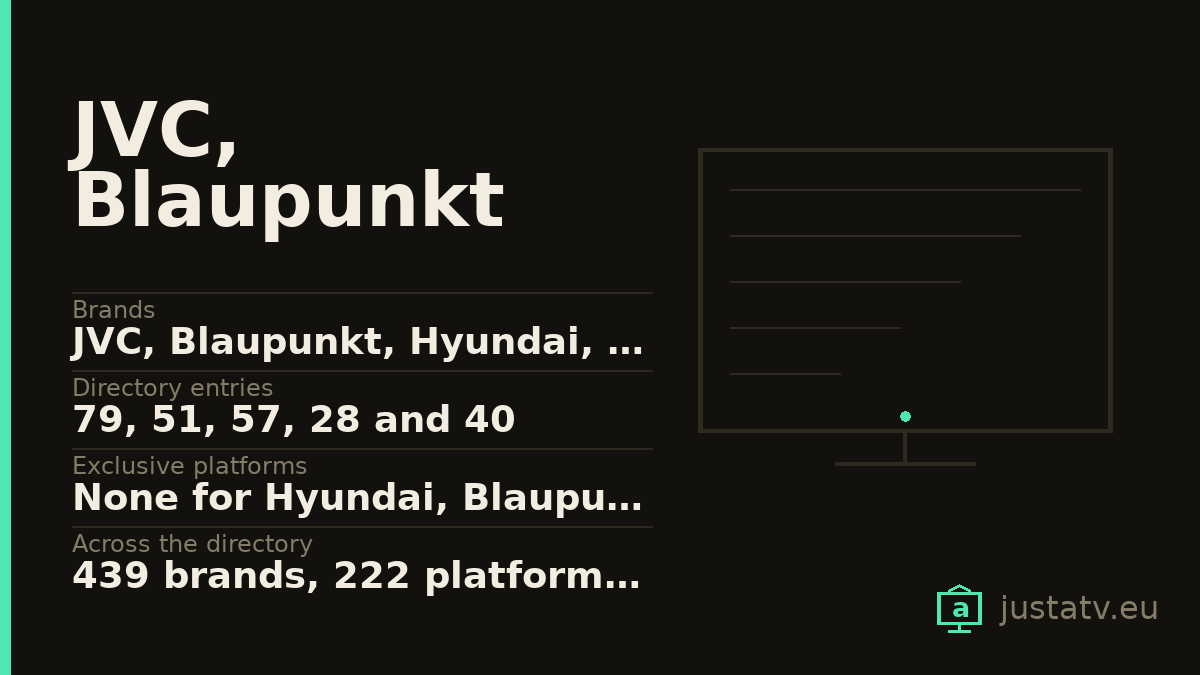
| Brands | JVC, Blaupunkt, Hyundai, RCA and Haier |
|---|---|
| Directory entries | 79, 51, 57, 28 and 40 |
| Exclusive platforms | None for Hyundai, Blaupunkt or RCA |
| Across the directory | 439 brands, 222 platforms, 91 % with none of their own |
| System | Android TV or Google TV by model; some ship VIDAA |
| Manufacturer | Not the name on the front |
| Memory | Almost no spec sheet publishes it |
| Source | Google Play device list and official brand sites |
In this site's directory, JVC is the brand with the most entries: 79. Behind it come Hyundai with 57 and Blaupunkt with 51. Philips has 48, Sony 45 and Samsung 36. None of those first three builds televisions.
Who puts the name on
Blaupunkt says so on its own licence information page: "BLAUPUNKT and the BLAUPUNKT logo are trademarks of Talisman Brands, Inc. and are used under license from Talisman Brands, Inc. BLAUPUNKT licensees are solely responsible for the BLAUPUNKT branded products manufactured, distributed and sold under license."
The footer of the RCA site reads "© RCA is a trademark of Established", and Blaupunkt's reads "© Blaupunkt is a trademark of Established". It is the same licensing company, established.inc, which claims 20 brands and more than 200 licensees. Thomson, Schneider, Saba and Proscan are in the same portfolio, and all four also appear in the directory.
Hyundai puts it in the footer of its Italian site, plainly: "Distributore per l'Italia, San Marino e Città del Vaticano: EUROCOM D.L.E. S.p.A. […] su licenza di HYUNDAI Corporation Holdings, Korea".
And JVC, the strangest case of all: neither jvc.com nor es.jvc.com sells televisions. Their categories are headphones, projectors, car electronics and professional gear. The brand with the most televisions in the directory has no televisions on its European site.
The proof is in the directory
For every model, the directory stores the device the set itself reports:
the platform it is built on. It comes from Google Play's supported devices
list, not from a sales catalogue.
Look at the elliniko platform. These six rows are verbatim:
Blaupunkt,BLAUPUNKT GOOGLE TV 4K,BLAUPUNKT,elliniko,tv
Hyundai,4K SMART TV,HYUNDAI,elliniko,tv
JVC,4K SMART TV,JVC,elliniko,tv
Motorola,4K SMART TV,MOTOROLA,elliniko,tv
Philips,4K SMART TV,PHILIPS,elliniko,tv
RCA,4K SMART TV,RCA,elliniko,tv
Six brands, one platform, and five of them declaring the same model name:
"4K SMART TV". Fifty-eight brands sit on elliniko in total.
The martin platform goes further. JVC, Blaupunkt, Hyundai and Schneider
share not only the device there but the same commercial territory string,
character for character: EU、UK、AP.
On tamachi the split shows up by country: the JVC row is annotated
france, the Hyundai one Italy and the Blaupunkt one Turkey. Three
brands, three markets, one set. It also matches what Hyundai's own Italian
site says, its distributor covering "Italy, San Marino and Vatican City":
another Hyundai entry in the directory carries exactly that territory list.
On sadang the same machinery shows up in the United Kingdom. There is a
JVC whose annotated territory is not a country but a retail chain,
Dixons, and beside it Logik, Cello and Linsar. Four names on the shelves,
one platform.
The full numbers, counted over the directory:
- JVC: 79 entries, 39 platforms, 37 of them shared with another brand. Only two are exclusively its own.
- Hyundai: 57 entries, 38 platforms, none exclusive.
- Blaupunkt: 51 entries, 34 platforms, none exclusive.
- RCA: 28 entries, 18 platforms, none exclusive.
- Haier: 40 entries, 14 platforms, three exclusive: its Galaxy and OLED ranges.
JVC and Blaupunkt overlap on 20 platforms. JVC and Hyundai on 21. Blaupunkt and Hyundai on 24. Anyone comparing a JVC with a Blaupunkt in a shop has decent odds of comparing the same set with two stickers on it, and the price reflects no technical difference whatsoever.
The whole map: 439 brands across 222 platforms
JVC, Hyundai and Blaupunkt are not three odd cases. Counted over the
entire list, and leaving out the 209 players and set-top boxes it
also holds, what remains is 2,228 televisions under 439 brand names,
spread across 222 platforms. Of those 222, 101 carry more than one
brand, and some carry a crowd: 60 brands on alimos, another 60 on
dangni, 58 on elliniko, 54 on osaka.
Turned around, the number reads like this: 401 of the 439 brands never appear alone on any platform. Not one of the sets they sell is a set nobody else sells. That is 91 % of them.
The other end looks nothing like it:
Sony        26 platforms, 25 exclusive
TCL         20 platforms, 20 exclusive
Philips     32 platforms, 21 exclusive
Hisense     12 platforms,  3 exclusive
Hisense is in that table to show that building the things does not get you out of the arrangement either: nine of its twelve platforms carry other brands as well.
And the ones with none at all:
Sharp       19 platforms,  0 exclusive
Tesla       12 platforms,  0 exclusive
Thomson     11 platforms,  0 exclusive
Grundig      9 platforms,  0 exclusive
Nokia        8 platforms,  0 exclusive
Schneider    8 platforms,  0 exclusive
TD Systems   8 platforms,  0 exclusive
Hitachi      4 platforms,  0 exclusive
Sanyo        2 platforms,  0 exclusive
Telefunken   1 platform,   0 exclusive
One detail comes out of counting the model names, and it sums the
situation up better than any percentage: 109 different brands sell a
television whose model reads, literally, AI PONT, across eleven
platforms. Another 77 report 4K SMART TV, and 62 more 2K SMART TV.
These are not catalogue names: it is what the firmware answers when
asked what it is.
Worth saying what this does not cover: Samsung and LG are not in that count, because Tizen and webOS are not Android and so never enter a Google Play list. Their 36 and 34 directory entries come from a second list, the one of historical series. The above is the Android TV and Google TV half of the market, which is exactly the half with packages to switch off.

Seven brands from one house
Haier is the other extreme: it does manufacture. And on the hanyang
platform the directory credits it with seven different trade names:
Haier, Candy, EVVO, Haitech, HEC, INNOVA and Magelite. Blaupunkt, Hyundai
and Linsar sit on the same platform too. The pattern repeats on nippori
with the 2K versions.
The oddest case is R1 and R2. There, JVC, Hyundai, Nokia, Thomson,
Schneider, Acer, Hitachi and Sanyo all declare the same model, ATV R1,
and Panasonic declares PANASONIC TV on the same device.
How to tell which one is yours
Stop searching by brand and search by platform:
adb shell getprop ro.product.device
Whatever comes back (elliniko, martin, hanyang, whatever it is) is
what to look up in the directory. And here is the useful
part: a package list for a Blaupunkt works for the JVC that shares its
platform, because the software does not come from the name on the front.
With no ADB to hand, Settings → System → About shows the model and the Android version, which already narrows it down a lot.
The official spec sheets disagree with themselves
The Hyundai HN-43EV3USG is a good example. Its official Italian page says, in the specifications table, "Sistema Operativo: Google TV". The PDF datasheet for the same model, hosted on the same site, says "Sistema Operativo: Android™ 11". A few lines below the table, the body text talks about "Le TV Hyundai con sistema operativo Android".
What that sheet is clear about: energy class F, UHD 4K, HbbTV 2.0, DVB-T/C/T2/S/S2, three HDMI and two USB. The HN-65VA3USG in the same catalogue has four HDMI. Neither lists RAM or storage.
And do not assume the system: that same eleven-set catalogue has five with Google TV, two with VIDAA (which is not Android, and where there is no ADB and no package to disable) and four that are not smart at all. One brand, one country, three different worlds.
Memory, which is what decides the lifespan
Almost no spec sheet publishes it. Of the 80 televisions in Haier's Spanish catalogue, exactly one states how much RAM it has: the H43S80FUX, with "2GB de RAM".
The interesting exception is a Blaupunkt from the Latin American site, the BLAU754K, which does publish the whole table: 1.5 GB DDR3 of memory, 8 GB of flash, a dual-core ARM Cortex-A9 at 1.2 GHz, under 300 W of consumption and under 0.5 W in standby. On a 75-inch set. That same page announces "ANDROID TV™ 9 OS" in one block and "Sistema Operativo: Android 6.0" in the table five lines further down.
You do not have to believe either one. With ADB connected:
df -h /data tells you how much storage there is and how much is free.
cat /proc/meminfo | head -1 tells you the total memory.
If less than two gigabytes are free, the clean-up stops being optional: a set with no room cannot update its apps or, eventually, its own system.
What comes off and what does not
Off without thinking: the streaming apps you do not use, the free content channels on the home screen, and the demo modes, very common in this range because these are sets designed to look good on a supermarket shelf.
Look first: the recommendation engine
(com.google.android.tvrecommendations) leaves the home screen clean, but
it also empties the "continue watching" row.
Do not touch: Google Play services (com.google.android.gms), the
launcher (com.google.android.tvlauncher on Google TV,
com.google.android.leanbacklauncher on Android TV) and anything starting
with com.android. that you cannot identify.
All of this is reversible: a disabled package comes back with one command, and a factory reset returns the set to the box.
If you have one
From these sets we mostly need one thing: the output of
adb shell getprop ro.product.device alongside the brand and the
commercial model code. With that we can confirm which brands are the same
set, which is exactly what none of them publishes. The general method is in
cleaning up an own-brand
TV.