
TCL: the same TV under several names
· 7 min read
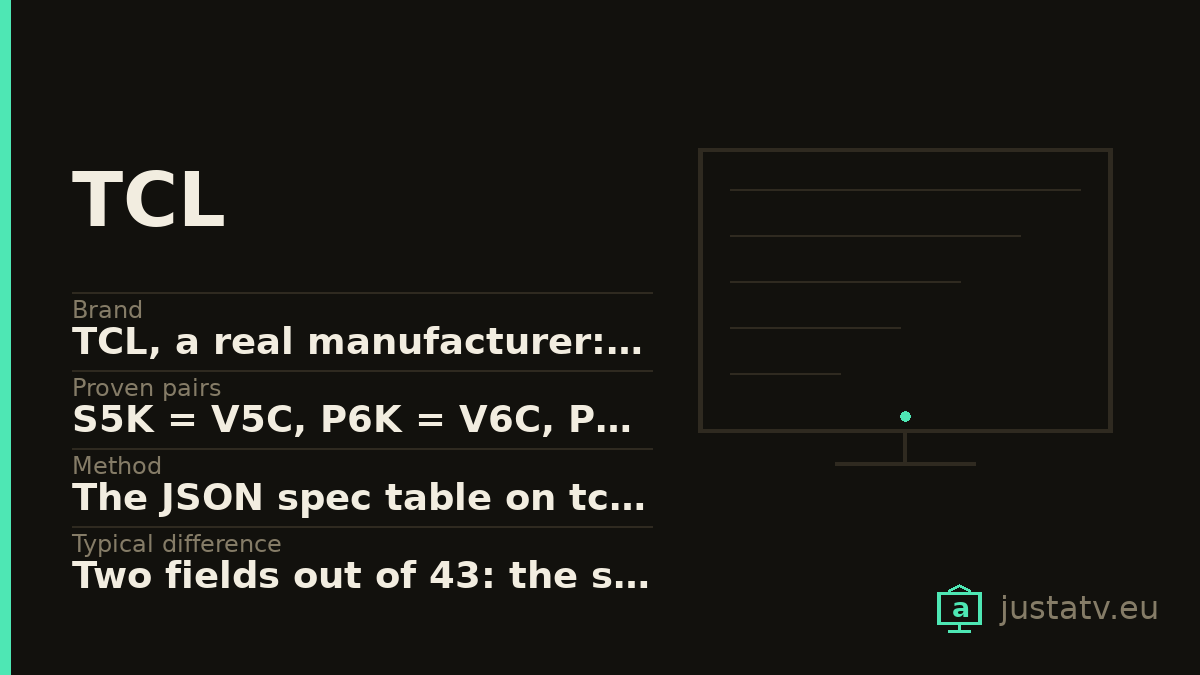
| Brand | TCL, a real manufacturer: 20 own platforms in the Google Play list |
|---|---|
| Proven pairs | S5K = V5C, P6K = V6C, P7K = T6C, SF560K = V5D |
| Method | The JSON spec table on tcl.com and the (EU) 2019/2013 product fiche |
| Typical difference | Two fields out of 43: the series name and the model name |
| System | Google TV on the P6K and P7K; Fire TV on the T6C, SF560K and V5D |
| Countries | Spain, Germany and the UK, all checked on the same day |
| Suppliers | Three of them sign the same models in EPREL |
| Registrations | 23 European fiches for a single 32" Full HD television |
| Not published | No RAM and no storage, except on the German SF540 |
| Empty names | UHD870, QLED770, FHD7900 and MQLED87 have no fiche and no page |
TCL is not an own-brand label. In the official Google Play device list it has twenty television platforms and all twenty are its own, while 401 of the 439 brands in that same file never appear alone on any platform. JVC, Hyundai and Blaupunkt sell somebody else's set with their own badge on the front, and that is counted here. TCL really does manufacture.
And even so, the same television leaves its factory under four names, depending on the country and the shop. This is not white labelling: it is the manufacturer multiplying part numbers over its own catalogue. The effect on the buyer is the same, that comparing two models can mean comparing one model twice.
How this is checked
The tables on tcl.com are not in the HTML: they are fetched separately, as JSON, one per screen size. Downloaded for Spain, the UK and Germany on the same day and compared box by box, they show when two names carry the same table.
The second proof is EPREL, the database behind regulation (EU) 2019/2013. There is no marketing there: there is screen area, watts and an energy class. If two references declare the same figures, that is one set measured once and written down twice.
The S5K is also sold as the V5C
The German tables for the 32S5K and the 32V5C have 43 fields each.
Forty-one are identical. The only two that change are Serie and Modell.
The same holds field by field at 40 and 43 inches: the same FHD QLED TV,
VA panel, 1920×1080, 60 Hz, HDMI Version 1.4b with no eARC, BT5.0,
WiFi 4, 100*100 VESA, and the same millimetres and the same kilos.
In the UK the same thing happens with the one size sold there. The
50S5K-UK and the 50V5C-UK have 38 fields and 35 match: Family,
Series and Customer Model are the ones that differ.
EPREL confirms it. The 43S5KX1 (registration 2179797) and the
43V5CX1 (2179919) both declare class F in SDR and G in HDR, 45 W in
SDR and 60 W in HDR, 49.8 dm² of visible area and LED_LCD. Two
registration numbers, one measurement.
The P6K is the V6C, and the P7K is the T6C with Fire TV
The 4K case is cleaner still. The German tables for the 43V6C and the
43P6K have 42 fields and 40 are the same; only the series name and the
model name change. Same at 50 inches. And EPREL signs it off again: the
43V6CX1 (2179795) and the 43P6KX1 (2268549) both declare F/G and
45 and 72 W; at 50 inches both are E/G with 50 and 78 W.
The T6C is the same exercise with a twist. Against the P7K, the German
table has 46 fields and 43 match. The three differences are the series,
the model and one box: Bedienung System, which reads FIRE TV on the T6C
and Google TV on the P7K. Same panel, same 350 nits, the same
956*600*185 millimetres, the same 716*185 stand, the same 6.6 kg. One
television, two operating systems, two catalogue references.
EPREL does not follow here, and that is worth saying: the 43T6CX1
(2179793) declares class G with 54 and 94 W, and the 43P7KX3
(2383574) declares F with 50 and 85 W. The commercial table says they
are the same set apart from the system; the regulated document says they draw
different power. One of the two sources is wrong, and TCL publishes both.
The same pair, a different story in the UK
The striking part comes when that pair is read on the British site. There the
43T6C-UK and the 43P7K-UK do split apart, in fields that were identical
in Germany: 97% DCI-P3 against 93%, contrast 6000:1 against 5000:1,
HDR 10+ at No against Yes, Bluetooth 5.0 against BT5.2, and both
AMD FreeSync and Game Master at No against Yes. The dimensions and
the weights, on the other hand, match to the millimetre.
Two names, two countries, two versions of what they are. It is the same
pattern already visible on the Q6C and the Q7C, where the 85Q6C is
class D on the Spanish page and F on the German one, and where the
50Q7C publishes 2000 nits (peak) in Spain and Germany and no figure at
all in the UK.

SF560K and V5D, plus a correction
The British SF560K is sold as a "Full HD QLED Fire TV" and the V5D is its
2026 name. In EPREL they are indistinguishable: 43SF560X1 (2179796) and
43V5DX1 (2538320) both declare F/G, 45 and 78 W and 49.8 dm². At 32
and 40 inches they also match: 27/35 W and 39/68 W.
One idea worth correcting: the SF560K is not the S4K. Its declared
resolution is 1920x1080 and the S4K's is 1366×768. It shares the cabinet
(same VESA, the same 715*465*180, the same 683*180 stand) and it shares
its panel with the S5K, not with the S4K. The 32-inch cabinet is the same for
all three; what changes is the panel inside it.
How many times one television gets registered
Counting only the 32-inch Full HD set, EPREL holds 23 registrations. Fourteen declare 27 W in SDR and 50 in HDR, and those are the S5K and the V5C. The other nine declare 27 and 35 W, and those are the SF560K and the V5D. One television, two measurements, twenty-three fiches.
The last letter of the identifier is not a product revision: it is who
registers it. X1 and X2 are always TCL Operations Polska, X3 and
X4 are TCL ELECTRONICS POLAND, and X7 through XC are TCL
Netherlands B.V. Three suppliers signing the same set, without a single
exception across the 206 registrations collected.
And there is one case where even the measurement does not hold: the 50T6C
appears with 60 and 90 W in two registrations and with 63 and 95 W in
five others. Same name, same size, two figures.
Names that lead nowhere
The German sitemap publishes addresses for mqled87, mqled98, uhd870,
qled770, fhd7900 and hd7900. All six answer 200, and all six serve
the general television catalogue, with no table and no fiche. In EPREL, not
one of those identifiers has a single registration. They exist as a name on a
shelf and as a URL, and they do not exist as a documented product.
The British case is stranger still: tcl.com/uk/en/tvs/c655k answers 200
and serves the P7K page, with its title and its table pointing at the
50P7K-UK.
And on the small German SF540, which uses a different table format,
something appears that appears nowhere else: Systemspeicher (DRAM) = 1.5 GB,
Interner Speicher = 8GB, and even the chip, T950D4 / 4x CA53 1.5GHz.
The table of equivalents
| Name | Where | Is | Proof |
|---|---|---|---|
| V5C, V5C-UK | DE, UK | S5K | 41 fields of 43 |
| V6C | DE | P6K | 40 fields of 42 |
| T6C | DE | P7K with Fire TV | 43 fields of 46 |
| V5D | UK | SF560K | Same EPREL fiche |
| MQLED80 | DE | QM8B | Separate page |
The Spanish QM8B and German MQLED80 pair is checked in its own
page, along with the T7B contradiction.
How to tell which one you have
What identifies the set is not the shop's part number:
adb shell getprop ro.product.device
Whatever it answers is the platform, and that is what to look up in the directory. With no ADB to hand, Settings → System → About shows the model and the Android version.
The practical part of all this: a package list for a V6C works on the P6K, and the S5K list works on the V5C. Software is not decided by the name on the front. The cleanup method for these sets, with the detail of what comes off and what does not, is in the S5K, S4K and C655 page.
And before comparing prices across countries or across chains, look at the table above. Both offers may be the same television.