
Mecool, Skyworth and RockTek: what they ship with and what comes off
· 8 min read
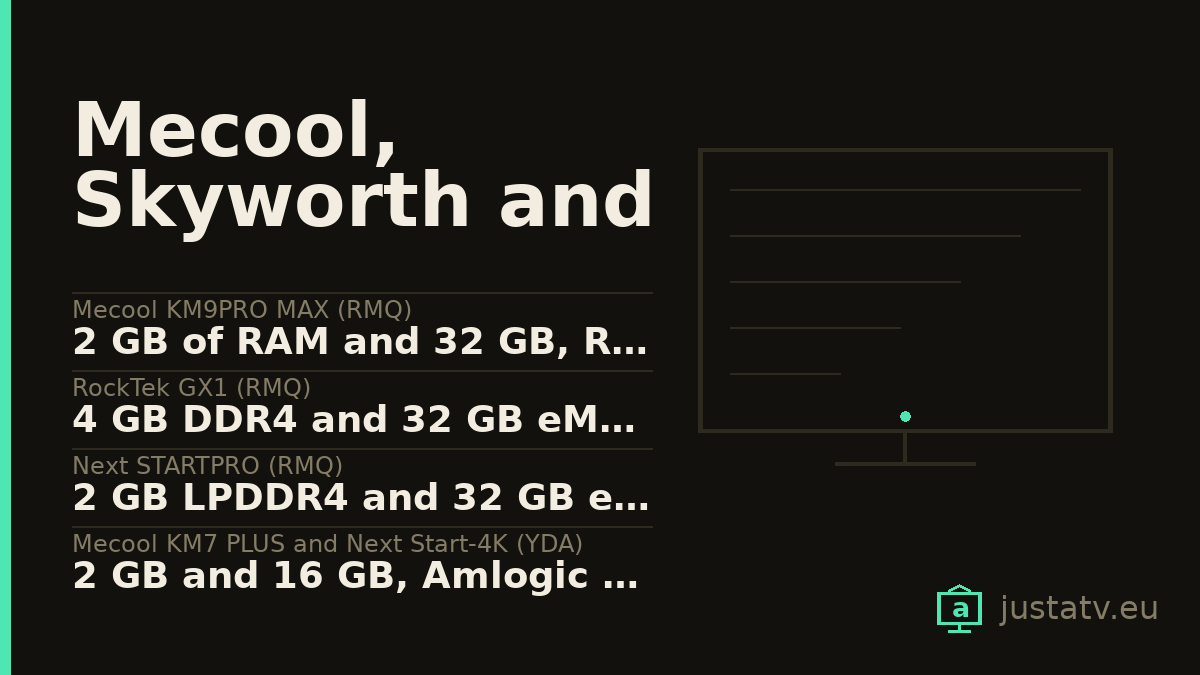
| Mecool KM9PRO MAX (RMQ) | 2 GB of RAM and 32 GB, Realtek 1325 |
|---|---|
| RockTek GX1 (RMQ) | 4 GB DDR4 and 32 GB eMMC 5.1, same Realtek |
| Next STARTPRO (RMQ) | 2 GB LPDDR4 and 32 GB eMMC |
| Mecool KM7 PLUS and Next Start-4K (YDA) | 2 GB and 16 GB, Amlogic S905Y4 |
| Mecool KM2 PLUS DELUXE (YYC) | 4 GB of RAM and 32 GB, Amlogic S905X4-J |
| Mecool MEgo1 4K (KHH) | 2 GB of RAM and 8 GB |
| Next 4K TV Stick (YYT) | 2 GB LPDDR4 and 8 GB eMMC |
| Certification | All five brands are on the Google Play device list |
| Years of updates | None of the five publishes a commitment |
| Skyworth and COOCAA | Publish no spec sheet at all for these boxes |
Search for "android tv box" in any shop and the same names always come up: Mecool, Skyworth, RockTek, COOCAA, Next. They cost between seventy and a hundred and fifty euros, they promise 4K and Google TV, and nobody looks at them seriously. This page looks at them with the one thing that is not selling anything: the list of Google Play certified devices this directory keeps, plus whatever each maker publishes on its own site.
The conclusion is awkward for all five brands. To a large extent they are the same box.
Six platforms, and two brands on every one
For each device the directory keeps the device the box itself reports: the
platform it is built on. Among the player rows there are 121 entries, 67
brands and 88 platforms. These six are shared by more than one brand, and
they are exactly the ones on this page:
YDA  COOCAA, Mecool, Next, QVWI, Skyworth, Strong, Thomson
YYT  CosMedia, Mecool, Next, realme, REGZA, Skyworth, Strong
RMQ  Mecool, Next, RockTek, Skyworth, Strong
KHH  Blaupunkt, Mecool, Skyworth, Strong
YYC  BOXY, Mecool, Skyworth, Strong
BOS  Mecool, Skyworth, eroc, realme
Skyworth and Mecool are on all six. And within each platform every brand
declares the same model: the five on RMQ say UHD Google TV STB, the seven
on YDA say 4K Google TV Box.
There is more. On YDA, three different brands (QVWI, Skyworth and Strong)
declare the same commercial name, Leap-S3, and Thomson declares LEAP-S3+.
On YYC, Strong declares KM2 PLUS DELUXE, which is Mecool's own product
name. Nothing needs interpreting: they sell the box to each other without
bothering to rename it.
What the link between Skyworth and Mecool actually is
This is worth getting right, because the temptation is to close the circle without a source. Skyworth is a Chinese maker of televisions and set-top boxes; its listed subsidiary, Shenzhen Skyworth Digital, sells Android TV boxes to operators (HP44H, HY42G, HP43A) and publishes not one spec sheet for the Leap range it declares on Google's list. COOCAA is Skyworth's, and it says so: its European site states that "coocaa is a registered trademark of the market-leading TV manufacturer SKYWORTH". So is Strong, since 2015, as told on the Kivi and Strong page.
Mecool is another matter: a Shenzhen brand, Bao'an district, that sells
through its own shop and presents itself as a "Google certified partner". No
downloaded source documents any corporate link between Mecool and Skyworth.
What is documented is the platform overlap, and that Strong, which belongs to
Skyworth, sells under its own name both Skyworth's Leap-S3 and Mecool's
KM2 PLUS DELUXE. That is enough to buy well.
Memory, which is the only thing that decides the years
These boxes do publish RAM and storage, unlike many televisions. These figures come from the makers' own sites:
- Mecool KM9PRO MAX (
RMQ): "RAM & Flash: 2GB & 32GB", with "Chipset Realtek 1325" and Google TV on Android 12. - RockTek GX1 (
RMQ): "4GB DDR4 Memory + 32GB eMMC5.1 Storage", on "Realtek RTD1325". - Next STARTPRO (
RMQ): "RAM: LPDDR4 2GB" and "Flash (ROM): 32GB eMMC". - Mecool KM7 PLUS (
YDA): "2GB DDR4 +16GB EMMC", Amlogic S905Y4. - Next Start-4K (
YDA): 2 GB LPDDR4 and 16 GB eMMC, the same S905Y4. - Mecool KM2 PLUS (
YYC): "2GB RAM 16GB ROM". - Mecool KM2 PLUS DELUXE (
YYC): 4 GB of DDR4 and 32 GB of eMMC. - Mecool MEgo1 4K (
KHH): "RAM & Flash: 2GB & 8GB". - Next 4K TV Stick (
YYT): 2 GB LPDDR4 and 8 GB eMMC.
Compare that with what is already documented here. The Chromecast with Google TV (4K) has 2 GB and 8 GB. The Xiaomi TV Box S (2nd generation), the same. The Google TV Streamer, 4 GB and 32 GB. In other words: almost this whole range has the RAM of a Chromecast and the storage of a Streamer. Not a bad place to be for seventy euros, but it is not a Streamer.
Then there is what is not published. Mecool gives no RAM and no storage for the KD3 or the KD5. Strong publishes storage and never RAM. Skyworth and COOCAA publish no spec sheet at all for these boxes.

The RMQ case: one board, two different memories
This is the figure that makes the comparison useful. Five brands declare
RMQ, and two of them publish the chip: Mecool says "Realtek 1325" and
RockTek says "Realtek RTD1325". The same board. But Mecool and Next sell it
with 2 GB of RAM and RockTek with 4 GB. Next and RockTek even describe
the same pair of board features with the same initials, AIPQ and AISR.
So the platform identifies the hardware, not the product. Two boxes identical inside can carry half the memory of one another, and that is exactly what decides how many years they last. The practical snag: the 4 GB version is RockTek's, a Taiwanese company (RockTek Co, Ltd.) that ships within Taiwan.
Certified, and that does matter
Being on the Google Play device list means the box passed certification: it brings the Play Store, Google services, built-in Chromecast and system updates. All five brands are there. The spec sheets repeat it: Mecool writes "Google Certified Android TV Box" and Next, "Netflix Certified, Google Certified" with "Google Widevine L1", which is what allows real 4K Netflix.
That separates these boxes from the pile of anonymous market-stall devices that advertise "Android TV" without being it, where Netflix never rises above standard definition and the store is an APK installer.
What certification does not say is how long it will last. None of the five
publishes a commitment in years. The only dated thing in the whole batch is
a Mecool blog post: the KM9PRO MAX moved to Android 14 with firmware
C1.0.6-20260116, having shipped with Android 12. A real update, with no
calendar behind it. Strong, which sells the same range, says it is moving its
boxes to Android 14 "progressively" and that each reference takes "an average
of 2 months", with no date at all.
Who answers when it breaks
If six brands sell the same box, this is half the decision.
Mecool gives a one-year warranty and thirty days to return, but its shipping and return address is in Shenzhen. RockTek sells in Taiwan. Next is NEXTSTAR ELEKTRONİK, of Istanbul, and both of its boxes are listed as out of stock. COOCAA in Europe is Metz Consumer Electronics GmbH, of Zirndorf, and its European catalogue is televisions: the box it declares on Google's list is not sold here. Skyworth does not sell it under its own name in Europe either.
In practice the big shops carry very little. MediaMarkt returns two results for "mecool", the KD3 and the KM7 SE, at 69.99 and 91.99 euros. The rest arrives by import, or with the Strong name on the lid.
What comes off
And here is the good news on this page: these are Android TV boxes with the Play Store, so there is ADB and there are packages to remove. Everything this site explains for a television with Google TV applies here.
You enable it under Settings → Device preferences → Build number, pressing
seven times, and then under Developer options → Network debugging. From
there, the usual list: out go the streaming apps you do not use and the
preinstalled games. You do not touch com.google.android.gms, nor the
launcher while you have no other one working, nor anything to do with remote
pairing.
One detail specific to these boxes: several hide the store. Mecool itself explains that the Play Store is reached through Settings → Apps → See all apps → Show system apps → Google Play Store. Worth knowing before you uninstall anything, because that is how you reinstall it.
Which one, and is it worth it?
The first question answers itself with the overlap in front of you: if the box is the same, choose on price, on memory and on who will replace it. The brand is not an argument. Between two boxes on the same platform, the 4 GB one is the better buy over the 2 GB one even at twenty euros more, and one you can return to a European warehouse is worth more than one that has to go back to Shenzhen.
The second answer is colder. Against a Chromecast with Google TV or a Xiaomi TV Box S, most of these boxes tie on RAM and win on storage, and they add a network port, which those do not have. Against a Google TV Streamer they lose on RAM except for the GX1 and the KM2 PLUS DELUXE, and they lose outright on update commitments: Google publishes five years and these brands publish none.
If your television has run out of road, the full comparison is on external players. And if it is still usable, there is a free step before buying anything: change the app instead of the device, in lightweight players for an older TV.