
Orange, MEO and Vodafone set-top boxes: what they ship with and what comes off
· 7 min read
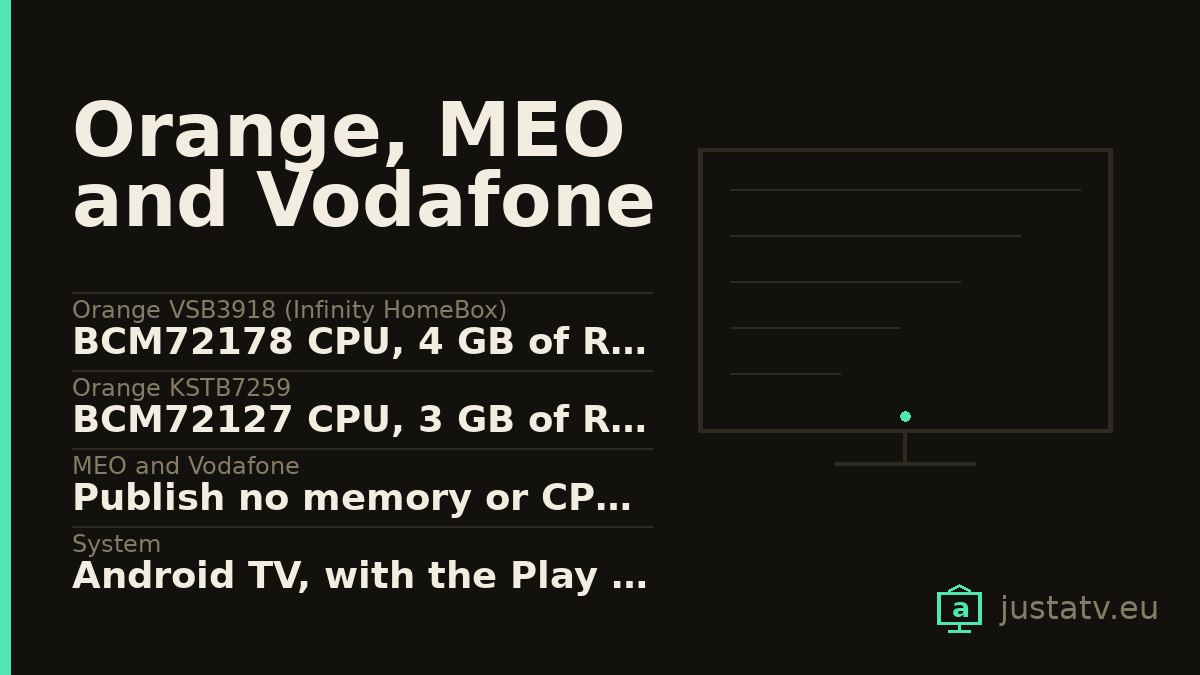
| Orange VSB3918 (Infinity HomeBox) | BCM72178 CPU, 4 GB of RAM and 32 GB |
|---|---|
| Orange KSTB7259 | BCM72127 CPU, 3 GB of RAM and 16 GB |
| MEO and Vodafone | Publish no memory or CPU for any box |
| System | Android TV, with the Play Store on Orange and Vodafone |
| Orange ownership | Free loan; €50 (€60.50 with VAT) if not returned |
| MEO ownership | Comodato; €110 including 23% VAT if not returned |
| Vodafone ownership | Comodato; €120 if not returned or returned tampered with |
| Return window | 15 working days at Orange, 30 days at MEO and Vodafone |
| ADB | No operator documents it |
This directory is written almost entirely about televisions. But underneath
millions of televisions in Spain and Portugal sits another box, and that box
is an Android TV too: the same Google packages, the same Play Store, the
same com.google.android.gms. What changes is not the technology. It is
whose it is.
Eleven boxes on Google's list
Google Play's official Android TV device list holds 121 devices that are not televisions, from 67 brands. Eleven of them are Iberian:
- Orange TV:
KSTB6130andKSTB7259, both sold as «Descodificador Orange TV». - Orange: three «Orange TV Box» entries with the codes
zc4455v_orb,zi4450v_orsandzc4450v_orm. The list does not say which country. - MEO(Portugal):
DV8555-MEO,DIW377-MEO,DIW3930-MEO,HP4C02-MEOandDV8985-MEO. - Vodafone:
HP46D, the «VODAFONE TV STICK 1».
The prefixes are not decoration. DIW377 appears just as literally at MEO,
at 1&1 (DIW377-1u1) and at SFR (DIW377_ALT_FR). DV8555 is at
MEO and at SFR (DV8555-SFR). And MEO's HP4C02 shares a family with
SALT in Switzerland (HP4CH-NJJ) and with Vodafone's HP46D.
Who actually builds them
One of the three families has a source, and it is the manufacturer's own. Sagemcom's support site lists, in the same «IP DSL Set Top Boxes» category, the «DIW387 UHD 1&1» and the «DEC DIW387V UHD ALT PT» (ALT PT is Altice Portugal, that is, MEO). Its search also returns «DIW377 1&1», «DEC DIW377 Alt ME», «DIW252 Lowi» and «VSB3918 Euskatel 16v».
That VSB3918 is the same code Orange Spain uses for its top box on its own
help site: «Descodificador premium Android TV (VSB3918) - Orange Infinity
HomeBox». The same French company builds Orange's box in Spain, MEO's in
Portugal and 1&1's in Germany.
For the DV#### and HP4## families I found no source saying who makes
them, and I am not going to guess. The only clue is in Google's list itself:
Ooredoo writes its model as SKW-HP44J-OTV, with the same HP44J stc uses.
Showing the overlap is already the finding.
The memory, which only one of them publishes
This one is a surprise: the operator that publishes most is Orange, and it publishes more than plenty of television makers. From its help pages:
- VSB3918 (Infinity HomeBox): «CPU BCM72178; 4GB RAM; 32GB almacenamiento interno», HDMI 2.1 with HDCP 2.2 and eARC, Wi-Fi 6, Bluetooth 5.0, Gigabit Ethernet and a DVB-T2 tuner.
- KSTB7259: «CPU BCM72127; 3GB RAM; 16GB almacenamiento interno», same connections minus the eARC.
That is 4 GB and 32 GB. Exactly what a Google TV Streamer has, and four times a Chromecast's storage. In memory terms, the box your operator lends you is a better device than the television you plug it into.
MEO publishes no memory or CPU for any MEOBox. Neither does Vodafone, for the decoder or for the TV Stick. Their help pages are about use, not specifications. That is a data point too.
The question that matters: is it yours?
No. And all three write it down.
Orange, in its General Conditions of February 2025: «Orange cederá sin coste mensual el uso y disfrute del Dispositivo al Cliente durante el plazo pactado». Its returns page puts it flatly: «El equipo es propiedad de Orange». If you do not return it, «una penalización de 50€ (60,50€ IVA INCLUIDO) por cada uno de ellos», and the window is 15 working days from the end of the contract.
MEO, in its Condições Gerais, clause 3.2 b): on rental or comodato the equipment «permanecerá propriedade da MEO», and the customer undertakes to use it as agreed «abstendo-se de o ceder, disponibilizar a terceiros ou introduzir-lhe alterações», that is, refraining from altering it. Thirty days to give it back. Its returns form prices the MEOBox at €110 including 23% VAT, with a sentence worth reading twice: «A emissão da fatura implica a transmissão da propriedade dos equipamentos». Pay, and the box becomes yours.
Vodafone is the most explicit of the three. Its consumer contract hands over the Equipment «compuesto de un decodificador y un mando a distancia» in «régimen de comodato (cesión gratuita)», and the customer undertakes «a no dañarlo, extraviarlo, cederlo, manipularlo ni efectuar modificaciones técnicas sobre el mismo». One month to return it and €120 if you do not, «o bien lo devuelve deteriorado o manipulado».
That word, manipulado, tampered with, is what separates this page from every other one on the site. On your own television, removing an app is your business. Here there is a signed contract saying it is not.

What comes off without leaving the contract
Quite a lot, actually, because the operators document the easy part.
All four of Orange's set-top box pages say the same thing: «al tratarse de
un dispositivo Android TV puedes acceder a la Play Store desde la sección
Aplicaciones». And they explain how to uninstall: drag the app «hasta el
icono de cubo de basura», with the warning that «hay determinadas
aplicaciones que no pueden ser eliminadas». Vodafone describes its Android
decoder as having «Apps precargadas para tu televisión y acceso a todas las
incluidas en Google Play Store». The MEOBox is on Google Play as
com.alticelabs.meo.androidtv.
What sits under the operator's launcher is the usual Android TV. What you cannot do is reach underneath it.
ADB: nobody documents it
I looked for developer options, ADB debugging and an Android version number across all three operators' official pages. They appear on none of them. Not to say they exist, not to say they do not. Not Orange across its four pages, not Vodafone, not MEO.
So there is no package list here and no command to copy. The honest thing is to say the operator does not document it, and that Vodafone's clause about «modificaciones técnicas» is in writing with a penalty next to it.
The real way out: the other HDMI
If you want to be the one deciding, the operator's box is not the place. The place is the HDMI input beside it, with a device that is actually yours. That is in external players: what they ship with and what comes off.
With per-operator caveats, and they matter:
- Orange allows for it: «Si el Cliente no desea conectar el descodificador al receptor de TV podrá descargarse la aplicación Orange TV en su Smart TV». It warns that without the box you may lose «determinados contenidos» or «ciertos canales Premium».
- MEO too: its App MEO TV asks for Android TV 9.0 or later.
- Vodafone does not. Its own compatible-devices page says «La App Vodafone TV no está disponible para Apple TV, dispositivos Android TV Box». With Vodafone, your own player covers everything except Vodafone TV.
And one Orange line worth remembering before imagining resale: «Este descodificador no permite el acceso a la señal de otros operadores».
What the box sees
It is an Android TV with the operator's account layered on top, so the data collection is the usual one plus the operator's, which also knows which channel you are watching. What can be turned off and what cannot is in what data your smart TV actually collects.
One helpful note from Orange: the Google account is optional. «Puedes saltarte estas pantallas y seguir utilizando el servicio de Orange TV con total normalidad».
If you have one
A package list from a MEOBox or a Vodafone decoder would be worth its weight in gold, because neither publishes anything. But before you pull one, read the contract: the device belongs to the operator, and there is a figure written next to the word «manipulado».