
Cheap HDMI sticks: what they ship with and what comes off
· 7 min read
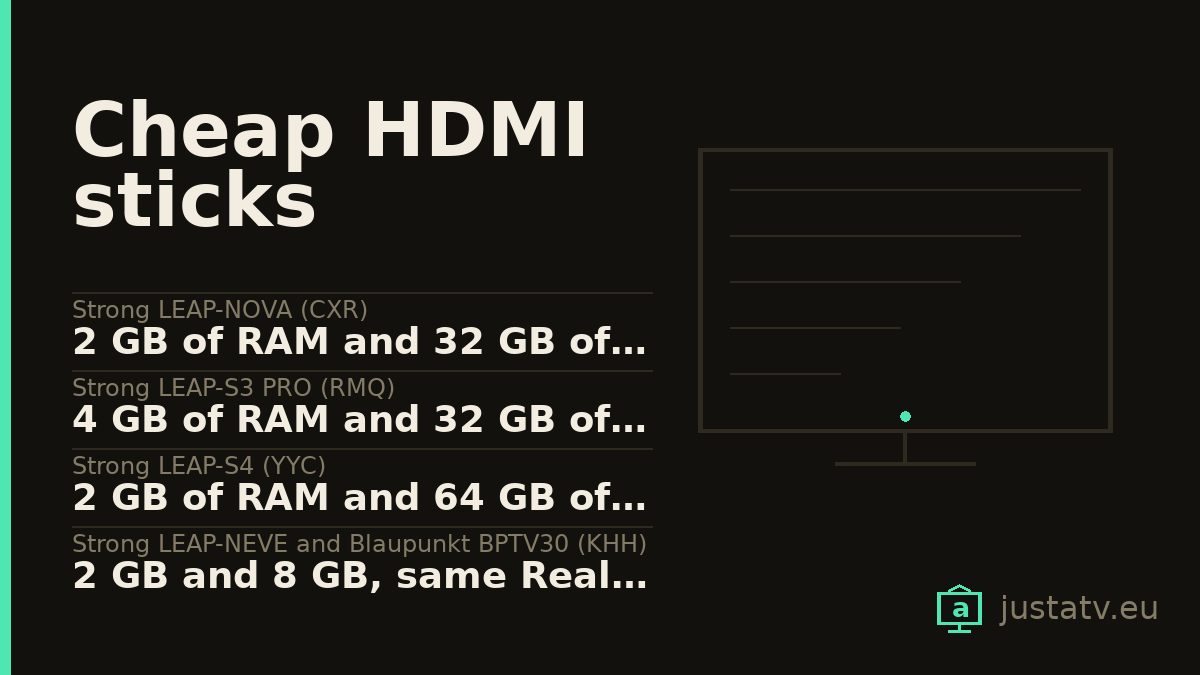
| Strong LEAP-NOVA (CXR) | 2 GB of RAM and 32 GB of storage |
|---|---|
| Strong LEAP-S3 PRO (RMQ) | 4 GB of RAM and 32 GB of storage |
| Strong LEAP-S4 (YYC) | 2 GB of RAM and 64 GB of storage |
| Strong LEAP-NEVE and Blaupunkt BPTV30 (KHH) | 2 GB and 8 GB, same Realtek RTD1325 |
| Strong SRT41 (YYT) | 2 GB of RAM and 8 GB of storage |
| Strong LEAP-S3 and Thomson LEAP-S3+ (YDA) | 2 GB of RAM and 16 GB |
| Strong LEAP-UNA+ (BKK) | 1 GB of RAM and 8 GB; Full HD only |
| techBITE Flix TV Box (DV8219) | 2 GB of RAM and 8 GB, Android TV 8.0 |
| Hykker Smart Box (DV8038) | 1 GB of RAM and 8 GB, Android TV 8.0 |
| BOXY 4K Android TV Box (YYC) | 2 GB of RAM and 16 GB |
| Years of updates | None of the brands publishes a commitment |
| Source | strong-eu.com leaflets, mPTech manuals and the Google Play device list |
Several pages in this directory end the same way: if nothing else fits on the TV, leave it as a screen and put a device in front of it. The entry step for those devices is the HDMI sticks sold in every European shop, and readers always arrive with the same question. Does one really fix an old TV, or does it just move the problem a few centimetres?
The answer depends on the model, and one figure decides it. Here are the figures for thirteen of them.
Where the list comes from
From the Google Play device directory, which this site has downloaded in full. Of its 2,437 rows, 121 are players, and those 121 spread 67 brands over 88 platforms. In other words: there are fewer distinct devices than there are names on the boxes, and the directory shows which is which because every row carries the technical name of the platform.
Memory, the one thing you cannot add later
The comparison that matters is in the external players page: Chromecast with Google TV has 8 GB and 2 GB, the Google TV Streamer 32 GB and 4 GB, and the second-generation Xiaomi TV Box S, 8 GB and 2 GB. Next to that, here is the cheap range, every figure taken from the manufacturer's own technical leaflet:
- Strong LEAP-S3 PRO (
RMQ): 4 GB of RAM and 32 GB of eMMC. - Strong LEAP-S4 (
YYC): 2 GB DDR4 and 64 GB. - Strong LEAP-NOVA (
CXR): 2 GB DDR4 and 32 GB, Amlogic S905X5M-J. - Strong LEAP-S3 and Thomson LEAP-S3+ (
YDA): 2 GB and 16 GB. - BOXY 4K Android TV Box (
YYC): 2 GB and 16 GB. - Strong SRT41 (
YYT): 2 GB DDR4 and 8 GB. - Strong LEAP-NEVE and Blaupunkt BPTV30 (
KHH): 2 GB and 8 GB. - techBITE Flix TV Box (
DV8219): 2 GB and 8 GB. - Strong LEAP-UNA+ (
BKK): 1 GB DDR4 and 8 GB. - Hykker Smart Box (
DV8038): 1 GB and 8 GB.
Read that again with the Chromecast in mind. Seven of these ten have 8 GB, exactly the same 8 GB that left the TV with no room. Buying one of those does not fix the problem: it repeats it, and adds a second remote.
The two with 1 GB of RAM are a different matter. The Hykker Smart Box that Biedronka sold in Poland for 179 zł is an Amlogic S805X at 1.2 GHz with Android TV 8.0 Oreo and a 1080p ceiling; its manual says so on the line "Pamięć RAM / Flash: 1 GB / 8 GB". The Strong LEAP-UNA+ is from 2026, runs Android 14 and still stops at 1 GB and Full HD. A stick like that is not a new TV: it is the same slow TV with a different home screen.
The three at the top do change something. With 32 or 64 GB there is room for the apps you use plus the updates of the coming years, which is exactly what was missing.
Why Strong has a platform of its own here
Strong has belonged to Skyworth since 2015, and says so on its own site: "STRONG Group, a Skyworth company", and "in 2015 STRONG became a member of the SKYWORTH Digital Group, a global leader in set-top boxes".
That explains an oddity in the directory. Of the 109 brands that declare
the AI PONT model, only five have any platform nobody else shares, and
Strong's two are precisely these sticks: BKK is the LEAP-UNA+ and CXR is
the LEAP-NOVA. Its TVs run on platforms shared with dozens of brands; its
sticks do not. The company behind it has spent thirty years making boxes that
plug into a TV, and it shows in which of the two products gets its own design.
There is more on that in the Kivi and
Strong
page.

The shop's box and the brand's box are the same box
This is what the directory shows best, and no box says it:
KHHis declared by Strong, Blaupunkt, Mecool and Skyworth. The Strong LEAP-NEVE leaflet and the Blaupunkt BPTV30 listing give the same Realtek RTD1325, the same 2 GB and the same 8 GB. They are the same device.YDAis declared by seven brands: Strong, Thomson, Skyworth, Mecool, Next, COOCAA and QVWI. Thomson's is called, literally,LEAP-S3+, which is Strong's own product name.YYCis declared by Strong, BOXY, Mecool and Skyworth.ts401is declared by CCC and TVCore, two brands with no product site. That samets401is documented as the stick Foxconn makes for a Japanese utility, with an Amlogic S905Y4, 2 GB and 8 GB.DV8038, the Hykker sold at Biedronka, is also an operator box sold in Brazil, and it shares a prefix with the boxes of MEO, Play, Sky Switzerland and TVPLUS. No downloaded source names the manufacturer, so it is not named here: what is visible is the overlap.
And one fact neither Polish brand prints on the box: the Hykker manual and the techBITE manual carry the same manufacturer details, mPTech Sp. z o.o., Nowogrodzka 31, Warsaw. The supermarket brand and the computer-shop brand are the same company.
Google TV certified: that part is a real difference
Being on the Google Play device list means the device passed certification, and therefore that it ships with the Play Store, Google services and system updates over the internet. Every device on this page is on that list, and Strong repeats it product by product: "Google TV certified stick (Android 14)". That is not nothing: the cheap alternative from a market stall is an uncertified box where Netflix never goes past standard definition.
What certification does not say is how long it will last. None of these brands publishes an update commitment. Strong's PSTI compliance table, which is where a brand writes down how long it supports each product, lists only routers, repeaters and cameras: not a single LEAP. Its extended four-year warranty does not cover them either, because the text itself says "only for all Home Networking products". For techBITE and Hykker there is nothing to look for: both devices shipped with Android TV 8.0 Oreo in 2018 and are still there.
What can come off
Here is the good news. These are Android TV with the Play Store, so everything
this site explains for a Google TV applies: turn on debugging in Settings →
Device Preferences → About, tapping the build number seven times, then in
Developer options → USB debugging. From there, adb shell pm list packages and start reading.
The streaming apps you never open and the preinstalled games come off with no
argument. Leave com.google.android.gms alone, leave the launcher alone until
you have another one working, and leave everything to do with remote pairing
alone. On a device with 8 GB, removing four apps you never open is the
difference between the next update fitting and not fitting.
So, does it fix the old TV?
It depends on the model, and now you know which. A stick with 32 GB fixes it: new system, new processor and years of headroom. One with 8 GB fixes nothing, because the problem you came to solve was the 8 GB. And one with 1 GB of RAM is worse than doing nothing.
What none of them touches is the panel: the brightness, the contrast and the HDR of your TV stay exactly as they were. If the picture was what bothered you, this is not the fix.
And before spending, check whether changing app is enough instead of changing device: that is in lightweight players for an older TV.