
NVIDIA SHIELD TV and SHIELD TV Pro: what they ship with and what comes off
· 7 min read
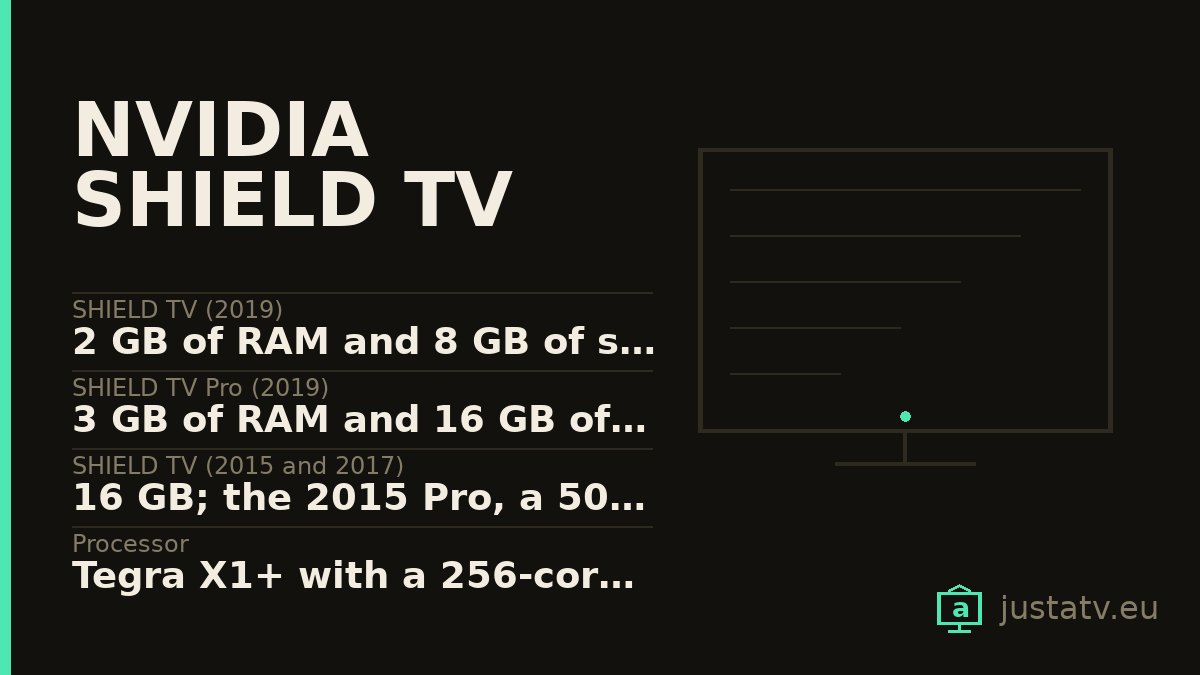
| SHIELD TV (2019) | 2 GB of RAM and 8 GB of storage, expandable by microSD |
|---|---|
| SHIELD TV Pro (2019) | 3 GB of RAM and 16 GB of storage, with two USB 3.0 ports |
| SHIELD TV (2015 and 2017) | 16 GB; the 2015 Pro, a 500 GB drive. The RAM is not published |
| Processor | Tegra X1+ with a 256-core GPU on both 2019 models |
| System | Android 11.0 with Android TV, per NVIDIA's own spec sheet |
| Published versions | 44 different ones across NVIDIA's three pages |
| Download Center dates | From 6.0.0 on 06/10/2017 to 9.2.1 on 12/05/2025 |
| The 2015 model | A 9.2.1 image published on 12/05/2025 |
| The gap | Three years between 9.0.0 (09/02/2022) and 9.2.0 (11/02/2025) |
| Price | 149.99 and 199.99 dollars; no euro price on nvidia.com |
| EPREL | No entry: NVIDIA and SHIELD both return zero results |
This directory has seventy pages repeating the same thing under different brands: whoever puts the name on the television did not build it, the memory is not published and support runs out after three years. The SHIELD is here because it is the counterexample. And a counterexample has to be looked at with the dates in front of you, not with nostalgia.
Four platforms it shares with nobody
The official Google Play device list this site uses has 2,437 rows. NVIDIA
takes five of them, across four platform codes: foster, darcy, sif and
mdarcy. None of the four appears under another brand anywhere in the list.
That is not the normal case: of the 390 codes in the file, 112 are shared by
two or more brands, because a third party builds the box and each brand puts
its own logo on top.
What each code is, according to what NVIDIA itself publishes:
fosteris the 2015 one. The README on therel-22r2-golden-fostermp-partnerbranch carries the product table:foster_eis the SHIELD Android TV Base andfoster_e_hddthe Premium, the one with the 500 GB drive. That same table is still on the 6.2.0 and 6.3.0 branch, which NVIDIA marks as 2015 and 2017.darcyis from 2017. The three source releases for the SHIELD TV China come offimaster_n_darcy_otabranches, and their README builds withlunch darcy_ironfist-userdebug.sifandmdarcyappear on no live NVIDIA page. On Google's list they are "SHIELD TV" and "SHIELD TV Pro", which are the 2019 pair and the only two the brand still sells.
The years, counted with NVIDIA's own dates
NVIDIA's release notes page carries no dates. The dates are somewhere else: in the Download Center JSON, where every recovery image has its day. Add up that page, the release notes and the open source page and you get 44 different versions of the SHIELD software.
Dated, they run from 6.0.0 on 6 October 2017 to 9.2.1 on 12 May 2025. There are more before 2017, going back to the "MP1", "MP2" and "MP3" factory images of the 2015 model, but NVIDIA no longer publishes their date.
The figure no other page on this site can show is in the file names: the 9.2.1 image dated 12 May 2025 exists for the SHIELD ANDROID TV 2015. A 2015 box with new software ten years later. And the most recent source drop, 9.2.2, still says "SHIELD TV (2015, 2017, 2019 edition)".
Now the uncomfortable part, which is in the same dates. Between 9.0.0, of 9 February 2022, and 9.2.0, of 11 February 2025, there is nothing. Three years and two days. This is not steady support: it is support that stopped and came back. The newest release note, 9.2.4, says "security patches are updated to Jan 2026", but that page does not say which models it reaches, so neither does this one.
Android: all three stopped at 11
This comes straight out of the release notes. Version 7.0 brought Android 8.0 Oreo. Version 9.0 is headed "Android 11 comes to SHIELD TV", and the open source page marks that 9.0.0 as 2015, 2017 and 2019: all three moved up to Android 11.
And all three stopped there. The two spec sheets NVIDIA still has live today, the SHIELD TV and the Pro, both still say "Android 11.0 powered by Android TV". A box sold new in 2026 running the Android of 2022.
The patch levels NVIDIA does write into the notes are five: June 2020, December 2020, September 2021, April 2022 and January 2026. Between April 2022 and January 2026 there is none written down.

Memory: here there are figures
NVIDIA is one of the few that publishes the RAM, and it publishes it on each model's sheet:
- SHIELD TV (2019): Tegra X1+ with a 256-core GPU, 2 GB of RAM and 8 GB of storage, expandable by microSD.
- SHIELD TV Pro (2019): the same Tegra X1+, 3 GB of RAM and 16 GB, with two USB 3.0 ports to hang a drive off.
Of the older ones only the storage survives, in the Download Center descriptions: 16 GB for the 2015 and the 2017, 500 GB for the 2015 Pro. The RAM of those two is on no live NVIDIA page.
There is one more figure almost nobody publishes and NVIDIA does: power. The Pro's sheet says "40 W power adapter" and "5-10 W typical consumption". The tube's says only that the power supply is built in, with no number next to it. That is not much, but it is more than most pages in this directory get, where consumption has to be dug out of the energy label.
Put next to the figures in the external players page, the result is less brilliant than the name sounds. The 2019 SHIELD TV has exactly what a Chromecast with Google TV has: 2 GB and 8 GB. What saves it is the microSD slot, which the Chromecast does not have. The Pro, at 3 GB, is the highest RAM figure on this whole site, but its 16 GB sits below the Google TV Streamer's 32 GB.
What it ships with and what comes off
It is an Android TV with the Play Store, so everything this site explains for a Google TV applies here, with the same menu paths. NVIDIA uses Settings → Device Preferences → About in its own guide, and the build number and the updates both live in there.
Preinstalled, per NVIDIA's spec sheet: GeForce NOW, Netflix, YouTube, Amazon Prime Video, Google Play Movies & TV, Freevee, Vudu, Amazon Music, the Play Store, YouTube Music, PLEX and Google Play Games. On the Pro, the Plex server as well.
From that list, whatever you do not open comes off with no argument:
com.netflix.ninja, com.amazon.amazonvideo.livingroom,
com.google.android.videos, com.google.android.youtube.tvmusic and
com.google.android.play.games.
Leave com.google.android.gms and com.google.android.tvlauncher alone
until you have another launcher working, and leave anything to do with remote
pairing alone too.
With NVIDIA's own apps you are going in blind, and that is worth saying: this
site's package database has no com.nvidia. entry at all. Before removing
anything of the brand's, pull the list off the box itself with
pm list packages and read it. There is a warning in the 9.2 notes that sets
the tone: installing it removes the SHIELD from the Google Home integration.
Is it worth it today?
With the dates in front of you, the answer splits in two.
For: it is the only box in this directory with an update history you can check file by file, with a 2015 model still inside it in 2025. It has gigabit ethernet, expandable memory and published RAM. None of those four things is common.
Against: the hardware is from 2019, the system is the Android of 2022, there were three years without a single version, and NVIDIA asks 149.99 dollars for the tube and 199.99 for the Pro. Its European pages carry no euro price, so what you pay here depends on the shop. For similar money there are players with more memory and a written support promise, which the SHIELD does not have: NVIDIA has never published a date up to which it will keep updating it.
Do not expect the European label either: set-top boxes do not carry one, and EPREL, when queried, returns zero results for both NVIDIA and SHIELD.
If what you have is a television without updates, before you spend anything look at what can still be done. Changing the box is not the first step.
If you have one
The package list exactly as your SHIELD returns it, with the SHIELD Experience version next to it, is worth more than any review: it is the only thing that says what actually came from the factory and how far yours really got.