
Toshiba MG8F and XA9D: what they ship with and what can come off
· 8 min read
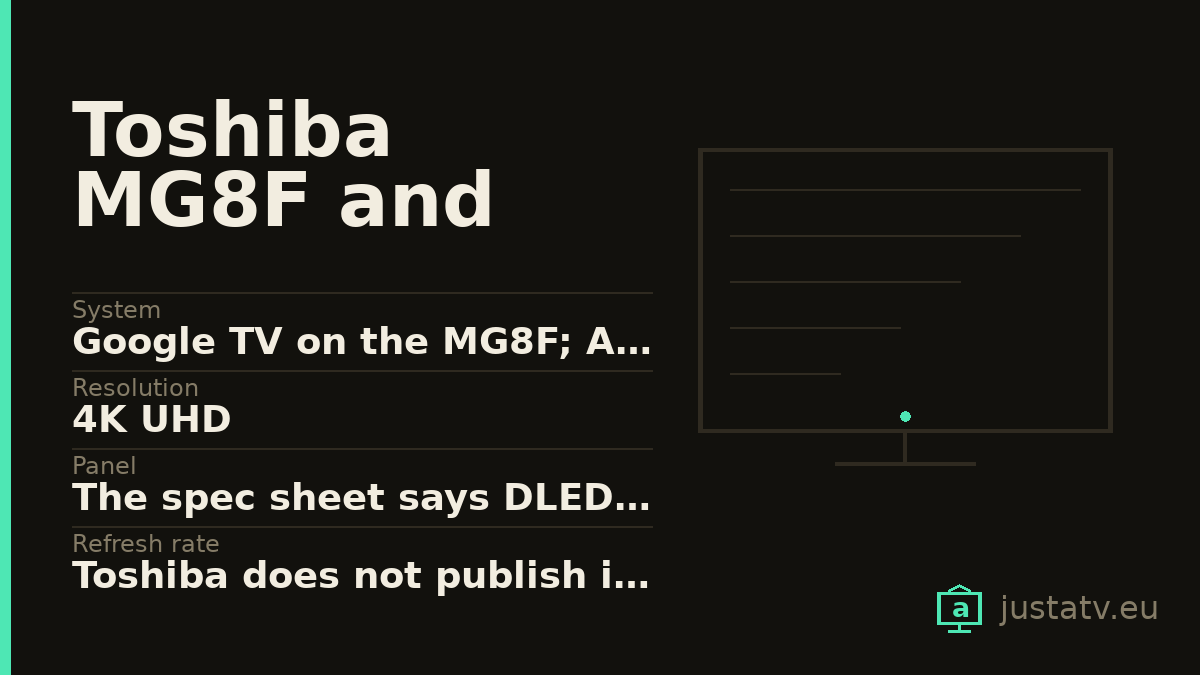
| System | Google TV on the MG8F; Android TV on the XA9D |
|---|---|
| Resolution | 4K UHD |
| Panel | The spec sheet says DLED on both; EPREL says OLED on the XA9D |
| Refresh rate | Toshiba does not publish it; EPREL states 100 Hz and 50 Hz |
| Brightness | 500 on both, with no unit declared |
| HDR | Dolby Vision; the spec sheet names neither HDR10 nor HLG |
| Memory | Neither RAM nor storage in any source |
| Sound | 2 × 15 W front firing on the MG8F; 2 × 12 W down firing on the XA9D |
| Subwoofer | Internal on both series |
| Connections | 3 HDMI and 2 USB |
| eARC | On HDMI 2 |
| Updates | 8 years in EPREL; the website says nothing |
| Sizes | 55" and 65" on both series |
The "Premium" category of Toshiba's Spanish catalogue holds exactly two series: the MG8F, which the website calls "4K UHD MINILED Google TV", and the XA9D, which it calls "Android OLED TV". Both are sold in 55 and 65 inches.
And they run different systems, which is the first thing to know if you are going to touch the app list: one is Google TV and the other is Android TV. The same catalogue also carries Fire TV and VIDAA sets, so with Toshiba the question "which system does it run?" has no brand-wide answer, only a per-series one.
An OLED whose spec sheet says DLED
Let us start with what makes this page different.
The XA9D is sold as an Android OLED TV. The marketing copy on its own PDF spec sheet talks about "this HDR OLED series" and about "pure black". And that same sheet, three paragraphs down, declares in the field Panel Type: Direct Back Light (DLED).
This is not a slip in the Spanish translation: the line is identical on the German, French, Italian and Portuguese sites.
The regulated sheet does clear it up. In the European EPREL register, the
55XA9D63DG is filed with panelTechnology: OLED. So the television is an
OLED and it is the commercial sheet that is wrong. But a buyer who only looks
at Toshiba's website reads "DLED" in the one field that describes the screen.
And a MiniLED that EPREL files as ordinary LED
With the MG8F the mirror image happens. It is sold as MINILED, its spec
sheet also declares "Direct Back Light (DLED)", and EPREL registers it as
LED_LCD.
Here no source backs the MiniLED at all: neither the commercial sheet nor the regulated record. Only the product name.
The refresh rate the site does not publish and EPREL does
The word "Hz" appears nowhere on either television's spec sheet. It is the same gap the UF3F already had.
EPREL fills it in: the 55XA9D63DG is registered with frequencyRate: 100
and the 55MG8F63DG with frequencyRate: 50. It is the largest difference
between the two series and it is written on no product page.
Three HDMI ports, and eARC takes one
Both series carry three HDMI inputs and two USB, and both put eARC on HDMI 2. The spec sheet says so, with the phrase "eARC Through HDMI2", and the manual repeats it: "Note: eARC is supported only via the HDMI2 input".
With a soundbar on that port you have two left for everything else. On a brand's top range that is more surprising than on a cheap set.
The 65-inch XA9D sheet adds "HDMI 2.1 with ALLM". The 55-inch one, same series and same document, says "HDMI 2.1 con TODO": somebody translated the acronym ALLM as if it were the English word all. Nowhere else in the sheet is the port version mentioned.
Sound and consumption
The MG8F carries 2 × 15 W with front-firing speakers and an internal subwoofer. The XA9D, 2 × 12 W down firing and also an internal subwoofer. Both are tuned by Onkyo, with DTS and Dolby Audio, and the marketing copy on both mentions Dolby Atmos.
On efficiency the MG8F wins clearly: class F in SDR, with 77 kWh per thousand hours on the 55-inch and 102 on the 65-inch. The XA9D is class G in SDR, with 113 and 147 kWh. In HDR both drop to class G.
Both declare Dolby Vision. Neither sheet names HDR10 or HLG.
No RAM and no storage, once again
We looked for both figures on the product pages of five countries, in the four PDF spec sheets, in the manuals Toshiba's own support site hands out for these models, and in the EPREL records. They appear nowhere.
And on a Google TV or Android TV set that is what decides its useful life: when storage fills up, apps stop updating and eventually the set cannot apply its own system update.
You can find it out yourself before installing anything else. With ADB
connected, df -h /data tells you how much there is and how much is free,
and cat /proc/meminfo | head -1 gives you the total memory. If you have
less than two gigabytes free, the cleanup this page describes stops being
optional.

Eight years of updates the website never mentions
In EPREL, all four models declare
minAvailabilitySoftwareUpdatesYears: 8 and minGuaranteedSupportYears: 7.
On Toshiba's website there is not one line about how many years these televisions are updated. And the warranty terms do not agree country to country either: the German version fixes twenty-four months; the Spanish one defers to "whatever the law in force sets at any given time", without a number.
So, for the same television: eight years in the regulated sheet, seven years of support in that same record, two years of warranty in Germany, and no written term at all in Spain.
Who answers if it breaks
Toshiba, on European televisions, is a licensed brand. The manufacturer is somebody else, and you do not have to deduce it: it is written at the foot of the warranty page itself.
"Vestel is the registered trademark licensee of TVS REGZA Corporation for the countries included in the Geographic Coverage section and the guarantor of the above Warranty Terms and Conditions."
That is the Spanish page, translated; the German, French, Italian and Portuguese pages say the same thing and name the same company. Below it comes the address: Vestel Holland B.V., with a Warsaw branch for the warranty and another in Garching, near Munich. Every page is footed "© 2024 VESTEL". In that same country list the United Kingdom carries "12 months warranty": a third, different term again.
In EPREL, all four models are registered to Vestel Holland B.V., not to Toshiba.
The manual that does not name your television
If you ask for the 55XA9D63DG manual on Toshiba's support site, you
download a PDF whose cover lists the UA22, UA32, UA2D, UA3D, UA4D, QA42,
UA5D, QA5D, QA7D and VA5D series. The XA9D is not on that list. The same
happens with the MG8F: the manual you get is the one for the UA23 and UA3E
series.
It shows in the small print of the sheet too, which still carries template leftovers: the MG8F publishes "Processor Type: 2024" (a year in the processor field) and "Dual Tuner: SPECDEFAULT", which is literally the form's default value.
What comes off and what does not
Google TV and Android TV share the method and nearly the whole list. ADB works exactly as on any other page of this site; what changes between the two series is the launcher.
What comes off without much thought: the streaming apps you do not use and the catch-up apps of channels you do not watch. They reinstall from the store in two minutes if you change your mind.
What not to touch: the store (com.android.vending), because without it
you cannot reinstall anything; the Google services (com.google.android.gms),
which half the list depends on; and the launcher, as long as you do not have
another one installed and working. On the XA9D that is
com.google.android.tvlauncher; on the MG8F, the Google TV one.
Nor anything starting with com.android. that you cannot identify:
com.android.systemui is the system interface and com.android.settings is
the settings app itself. And nothing to do with HDMI and external device
control, which is where the HDMI 2 eARC runs.
Write down what you remove, with the whole command beside it, and save the full package list before touching anything: it is the only faithful snapshot of how your television arrived.
If it breaks out of warranty
Since 31 July 2026, under Directive (EU) 2024/1799, Toshiba publishes indicative repair prices by country. In Spain they are 95 euros excluding VAT for a simple job and 190 for a complex one, which is the one covering boards, power supply, panel and LED bars, plus 45 euros for diagnosis, 65 euros an hour of labour and 25 euros of call-out within 30 kilometres.
It is worth reading before buying a television at this price. In Italy the same table starts at 160 euros and in Germany at 178.50. The German PDF publishes the Austrian price as "ab XXX,00 €".
All of this is reversible
Packages disabled from ADB come back with one command, and a factory reset returns the television to the state it left the box in. Nothing here touches the system.
If you own one
These two televisions are missing the same three figures missing from almost
the whole catalogue: RAM, storage and the panel's real refresh rate. The
output of df -h /data and cat /proc/meminfo, along with your app list,
would close a page that today leans on EPREL for the basics.