
Sony BRAVIA 2 II, X75WL and X80L: what they ship with and what comes off
· 8 min read
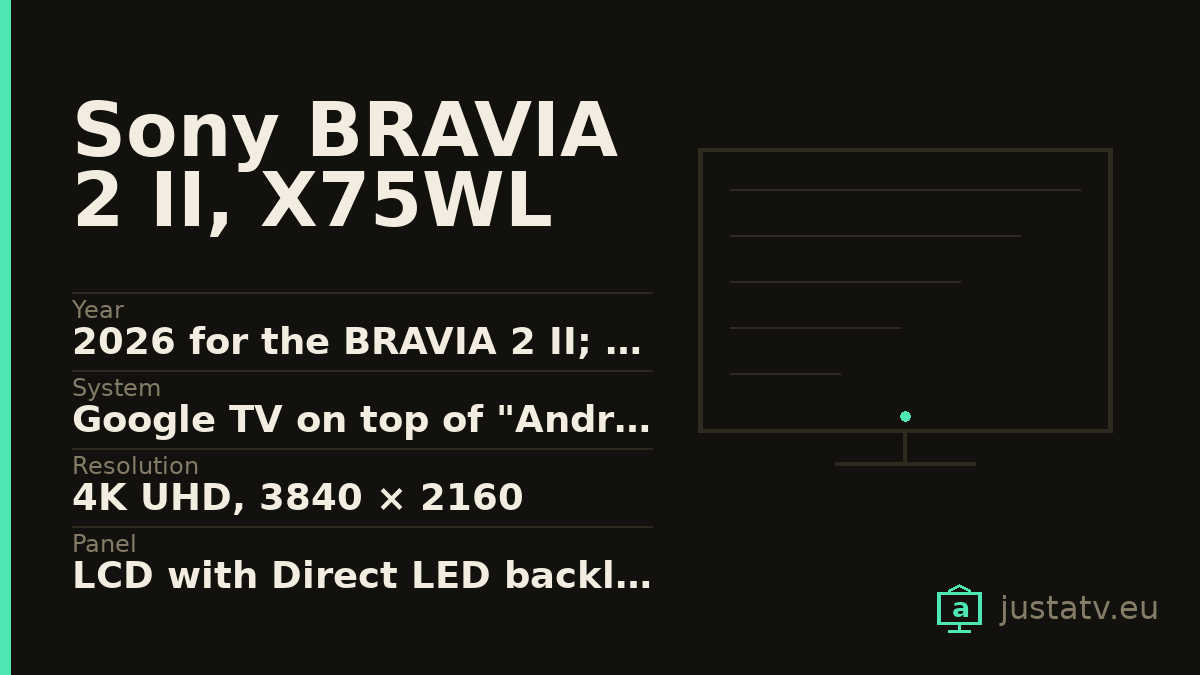
| Year | 2026 for the BRAVIA 2 II; 2023 for the X75WL and X80L |
|---|---|
| System | Google TV on top of "Android TV", with no version number |
| Resolution | 4K UHD, 3840 × 2160 |
| Panel | LCD with Direct LED backlight and frame dimming |
| Refresh rate | 60 Hz on the BRAVIA 2 II; 50/60 Hz on the X75WL and X80L |
| Processor | 4K Processor X1 on the BRAVIA 2 II and on the X75WL |
| HDR | HDR10 and HLG; only the X75WL and X80L add Dolby Vision |
| Storage | 16 GB on the BRAVIA 2 II; 32 GB on the X75WL and X80L |
| RAM | Sony does not publish it for any of the three |
| Connections | 4 side HDMI with HDCP 2.3; none of them supports VRR |
| eARC | They have it, but Sony does not say which port it is on |
| Sound | 10 W + 10 W on all three |
| Updates | 8 years of software on the BRAVIA 2 II European fiche |
| Sizes | 43", 50", 55", 65" and 75" for the BRAVIA 2 II |
Sony sells a good many more televisions from the bottom of its catalogue than from the top, and that is precisely the part nobody writes about. These are the three still standing below the BRAVIA 3: the BRAVIA 2 II from 2026 and the X75WL and X80L from 2023, which Sony's own site keeps published.
They go together because they share the same Google TV and because, set side by side, they say something that looking at one alone does not show.
The first thing to go is Dolby Vision
On the BRAVIA 2 II sheet, the HDR line reads exactly this: Yes(HDR10,HLG). Nothing else. On the X75WL sheet, three years older, it reads Yes(HDR10,HLG,Dolby Vision), and the X80L one says the same.
So the new model ships with less than the old one in the thing you notice most with films. If you got here from an X75WL assuming that replacing it meant moving up, better to know now than later. HDR10 and HLG are there, and everything works with them; what you will not see is the blue logo at the start of a Netflix title.
None of the three takes HDR10+, and none takes VRR: the Variable Refresh Rate (VRR) line is a dash on all three sheets.
The processor, and a name that changes by country
The BRAVIA 2 II carries the 4K Processor X1. The X75WL carries that same 4K Processor X1, and the X80L the 4K HDR Processor X1. For comparison upwards: the BRAVIA 3 also carries the 4K HDR Processor X1, and from the BRAVIA 5 on you move to the XR Processor, which is a different thing.
There is a detail here worth keeping for what it says about the care these sheets are published with: the same BRAVIA 2 II page calls it two different things depending on the country. On sony.es, sony.co.uk, sony.de, sony.fr and sony.pt it says "4K Processor X1". On sony.it it says "Processore X1 4K HDR", with an HDR the others do not have. Same set, same day.
And do not read the HDR off the name: the X75WL is called the same as the BRAVIA 2 II and does have Dolby Vision.
Four HDMI, and the eARC nowhere
All three have four HDMI inputs, all of them on the side, with HDCP 2.3 on all four. The sheet for all three says Features specified in HDMI2.1: eARC/ALLM. None of them accepts 4K at 120 Hz: the BRAVIA 2 II signal list stops at 3840 × 2160p at 60 Hz.
ALLM does change, and in the good direction: on the X75WL and the X80L it works only for HDMI™3/4, and on the BRAVIA 2 II it already works for HDMI™1/2/3/4. It is one of the few things the new model does better.
Where the eARC is, Sony does not say for any of the three. It confirms they have it (Yes (eARC/ARC)) and that is where it ends: there is no port number in any of the six language versions of the sheet we downloaded. In this directory that figure has turned out to be the one almost nobody publishes and the one that moves between ranges within a single brand. Here you have to read the printing on the back panel, which is where it is usually labelled.
What does improve from 2023 to 2026
On networking and radio the new model wins. The X75WL stops at Wi-Fi 802.11a/b/g/n/ac and Bluetooth 4.2; the BRAVIA 2 II declares Wi-Fi 6E on the British sheet and "Wi-Fi 6 or Wi-Fi 6E, depending on country/region" on the Spanish, French, Italian and Portuguese ones. Another place where the same sheet does not say the same thing in every country.
The sound does not move: 10 W + 10 W on all three. What changes is the speaker. The X75WL and X80L carry Bass Reflex with X-Balanced Speaker; the BRAVIA 2 II, an open baffle speaker with two full-range drivers. And both PlayStation 5 features, auto HDR tone mapping and auto genre picture mode, are on all three.
16 GB, and the RAM that never appears
The BRAVIA 2 II declares 16 GB of on-board storage. The X75WL and the X80L declare 32 GB. Here too the 2026 model sits behind the 2023 one, and this time it matters: Google TV on 16 GB leaves little room free once the four or five apps anybody uses are installed. That is the practical reason why removing what you do not use changes something on this television and almost nothing on a high-end one.
Sony does not publish the RAM for any of the three. It is not on the sheet in any country. If someone gives you a figure, it does not come from here.

The years of updates: eight, seven, or nothing
Sony's site does not say how many years it will keep updating these sets. None of the six versions of the sheet carries a line about it.
The European regulated fiche does. The ten BRAVIA 2 II registrations (the five sizes as S20M2 and the five as S25M2 EU) all declare the same: eight years of software update availability, seven of spare parts, seven of guaranteed support and two of warranty. The K-55S25M2 is registration 2651469; the K-55S20M2 is 2651455.
That is not five different figures, as it was with other brands, but it does not line up either: the same fiche declares the panel at 50 Hz while the product page declares it at 60 Hz. For the X75WL, on the other hand, we found no European registration at all searching by model.
What a BRAVIA with Google TV ships with
This is the part with names on it. The package catalogue on this site has
thirteen documented com.sony.dtv. packages, and those are the ones you will
find listed on a recent BRAVIA.
These come off with no consequences: com.sony.dtv.sonyselect (a shop window
of services that ends up sending you to the store), com.sony.dtv.promos
(Sony offers, and it wants an account), com.sony.dtv.notificationcenter
(nudges to use Sony's ecosystem), com.sony.dtv.smarthelp,
com.sony.dtv.livingfit (pictures on the screen, not the screensaver),
com.sony.dtv.osat.music, com.sony.dtv.recapp, com.sony.dtv.seeds.iot
(smart speaker control) and com.sony.dtv.timers, which on some launchers
leaves the timer button doing nothing.
With care: com.sony.dtv.ecodashboard breaks options in the settings app if it
goes, and com.sony.dtv.calibrationmonitor is Calman for BRAVIA, which is no
use here: auto calibration is not on this set's sheet.
And two that stay. com.sony.dtv.tvx handles the inputs: without it, HDMI
stops working. And com.google.android.tungsten.setupwraith, which looks
like a harmless first-boot helper, breaks the sound settings and volume control
on BRAVIA sets specifically.
The rest, as always
Streaming apps you do not use go without a second thought: they take up room, they update themselves and they fill the recommendation row. If you subscribe tomorrow, they come back from the store in two minutes. The button on the remote stays, mind, and stops leading anywhere.
Before touching any package, go through the television's own privacy settings: on recent Sony sets there is a fair amount to turn down from there, with no ADB and no risk. That road first.
And you do not touch Google Play services, nor the launcher while you have no
other one running, nor anything starting with com.android. you cannot name.
How to tell whether this is your television
Settings → System → About shows the model and the Android version. Over
ADB, getprop ro.product.model gives the same without menus. The BRAVIA 2 II
sells as K-43S20M2 to K-75S20M2 and as K-43S25M2 EU to K-75S25M2 EU; the
X75WL, from KD-43X75WL to KD-75X75WL; the X80L, from KD-50X80L to KD-85X80L.
All of this can be undone
Packages disabled over ADB come back with one command, and a factory reset returns the set to the state it left the box in. Nothing here touches the system: it only tells the television not to load something already installed.
If you have one
The app list from your BRAVIA 2 II, exactly as the set returns it, is the only thing missing to close its entry in the directory.