
Hisense U7Q and U7E: what they ship with and what comes off
· 7 min read
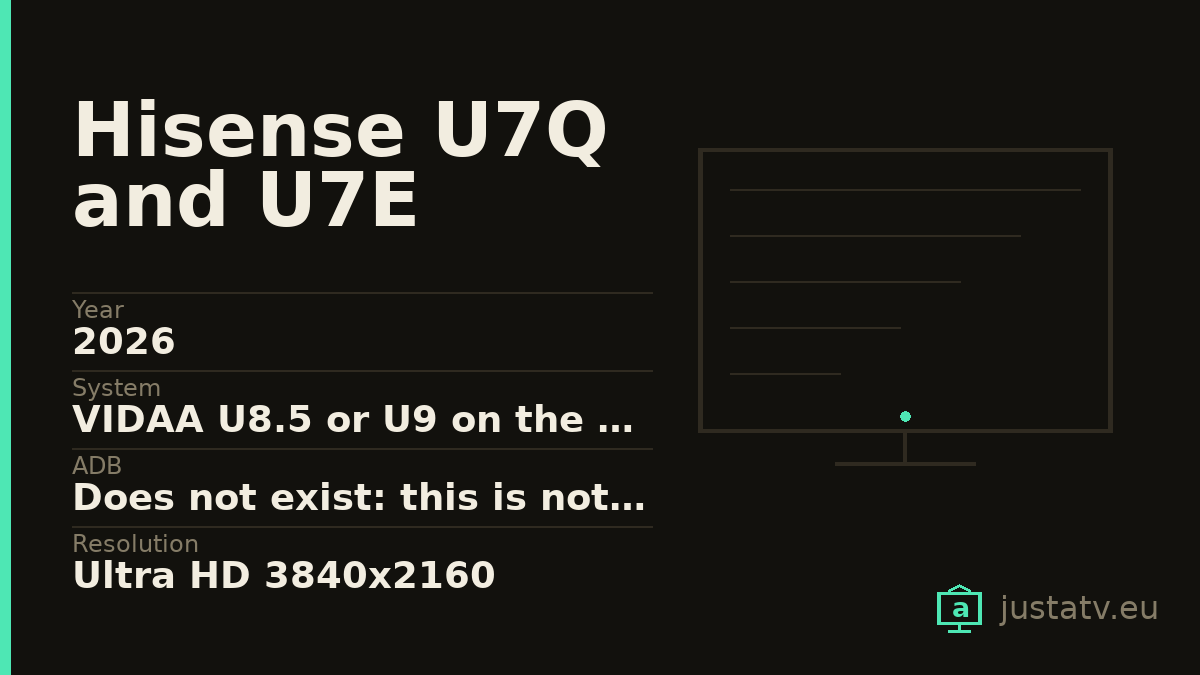
| Year | 2026 |
|---|---|
| System | VIDAA U8.5 or U9 on the U7Q; HomeOS U9 on the U7E |
| ADB | Does not exist: this is not Android |
| Resolution | Ultra HD 3840x2160 |
| Panel | Mini LED; VA or ADS depending on the size |
| Refresh rate | 144 Hz; 165 Hz only on the 100U7Q |
| Brightness | 900-1000 nits peak on the U7Q; 1300-1400 on the U7E |
| Dimming zones | 128 to 608 on the U7Q; 144 to 384 on the U7E |
| HDR | HDR10, HDR10+, HLG and Dolby Vision IQ; IMAX on the U7E only |
| Sound | 2 × 10 W plus a 20 W subwoofer; Devialet on the U7E |
| Connections | 4 HDMI, but only 3 and 4 reach 144 Hz |
| Wi-Fi | 802.11ac in the table; the brochure says Wi-Fi 6 |
| Memory | Hisense does not publish it |
| Sizes | U7Q from 50 to 100 inches; U7E from 50 to 85 |
First, the thing you came for if you arrived looking to clean one of these: you will not be able to do it over ADB. Not on the U7Q, not on the U7E.
That is not a limitation of the model, it is that they are not Android. The
65U7Q sheet declares VIDAA U8.5 in the operating system field, and the
65U7SE sheet says HomeOS U9. There is no USB debugging, no pm disable, no
package list to reach. We went through all 145 product sheets in Hisense's
Spanish catalogue and not one declares Google TV or Android TV.
What you can do is in the Hisense with VIDAA guide, and it is not nothing: turn off content recognition, cut personalised advertising, remove the apps the system lets you remove, and skip the account. This page is for the other half: knowing which set you are buying.
VIDAA and HomeOS are the same thing, and here you can see it
Hisense is renaming its system, and these two models catch the change
mid-stride. The U7Q declares VIDAA U8.5 across the five European sizes and
VIDAA U9 on the 100-inch. The U7E declares HomeOS U9 on all five of its
sizes, and the word VIDAA does not appear on its page once: the promotional
block titled "VIDAA" on the U7Q is titled "HomeOS" here.
That it is the same system does not have to be inferred, it can be checked. The
Portuguese sheet for the same 65U7SE does not say HomeOS: it says
VIDAA U9, same version number, in a field called "Interface do Utilizador"
there. One television, two catalogues from the same maker, two names for an
identical system.
How they actually differ
This is why the two share a page. In the shop window they are cousins; in the table, less so.
Peak brightness. The U7Q declares 900 nits at 50, 55, 65 and 75 inches, and 1,000 at 85 and 100. The U7E declares 1,300 at 50, 55 and 85, and 1,400 at 65 and 75. That is roughly 50 % more at the same size. On typical brightness, 450 nits for the U7Q across the range; 500 or 600 for the U7E.
Dimming zones. The U7Q runs from 128 zones on the 50U7Q to 352 on the
85U7Q, with 608 on the 100-inch. The U7E runs from 144 to 384. Size for size
the U7E always wins, though not by much: 260 zones against 220 at 65 inches,
384 against 352 at 85.
Sound. Both declare 2 × 10 W plus a 20 W built-in subwoofer at the middle
sizes. The difference is the signature: the U7Q lists Hi-Concerto 2.0, and the
U7E adds TUNED BY DEVIALET and Room Fitting Tuning.
HDR. Both declare HDR10, HDR10+, HLG, Dolby Vision and Dolby Vision IQ. IMAX Enhanced belongs to the U7E alone: in that field the U7Q says "No" at every size.
Recording. And this one surprises, because it runs the wrong way round. The U7Q declares PVR and Time Shift. The U7E says "No" to both, across all five sizes. If you record off air, the newer model is the one that does not.
The panel type changes with the size
Hisense publishes this and almost nobody looks at it, and it decides more than any nits headline.
On the U7Q the panel is VA at 50, 55, 65, 85 and 100 inches, with a declared
contrast of 5,000:1 (4,000:1 on the 50). The 75U7Q is ADS, and its
declared contrast drops to 1,200:1.
On the U7E the border sits elsewhere: VA at 50, 55 and 85, and ADS at 65 and 75, with 1,000:1 of contrast against the 5,000:1 of their siblings. The declared black level confirms it: 0.2 nits on the VA panels, 0.8 on the ADS.
Translated: buy a U7E at 65 or 75 inches and the panel is from the IPS family. Better viewing angles, worse blacks. That is a legitimate choice and it is published, but it appears on no shop sign. The Portuguese catalogue declares exactly the same panel types and contrast figures, so it is not a Spanish typo.

The four HDMI, and the two that run
Both series declare the same thing, and it is worth knowing before you route the cables:
- HDMI 1 and 2:
HDMI2.1 compliant (ALLM, 4K 60Hz). - HDMI 3:
HDMI2.1 (eARC, ALLM, VRR, 4K 144Hz). - HDMI 4:
HDMI2.1 (ALLM, VRR, 4K 144Hz).
So: four ports carrying the HDMI 2.1 label, of which only two reach 144 Hz, and eARC lives on one of those two. Plug the soundbar into HDMI 3 and you have a single fast port left for the console. With two consoles, one of them sits at 60 Hz.
The exception is the 100U7Q, which declares all four ports at 165 Hz and is
the only set in the family with that refresh rate in the Spanish catalogue.
What the brochure says and its own table denies
Two contradictions inside the same page, and both matter.
The wi-fi. The U7Q promotional block advertises "WiFi6E" and the U7E one
advertises "Wi-Fi 6". The specification table on both declares
IEEE 802.11 a/b/g/n/ac, which is Wi-Fi 5. In the eleven sheets we looked at,
without a single exception. If it matters to you, count on Wi-Fi 5 and keep a
cable or an adapter within reach.
The hertz. The 65U7SE page carries two blocks in a row: "144 Hz Native
Game Mode" and "165 Hz Native Game Mode". That model's refresh rate field says
144 Hz. The 165 belong to another size in the series, one Spain does not sell
and Portugal does: the 100-inch.
Bluetooth, on the other hand, genuinely does go up: 5.0 on the U7Q, 5.4 on the U7E.
What Hisense does not publish
Neither RAM nor storage. In none of the eleven sheets. And it is the figure that decides how many years a connected television lasts, because once storage fills up the apps stop updating. It stings more here than on an Android set, because without ADB you cannot check it yourself either.
The U7E's input lag. The U7Q declares it: 13.7 ms at 50 and 55 inches,
13.8 ms at 65 and 85. On the U7E that field is empty at four of the five sizes;
only the 85U7SE puts something in it, 13.8ms 4K 60Hz.
And one figure that is wrong. The U7E sheet declares 0 RF tuners while
also declaring an eight-day EPG, teletext, LCN support and a CI+ slot. Both
cannot be true. We record it exactly as it stands, without fixing it ourselves.
How to tell which one you have
The U7E is sold as the "U7E series", but the device code is U7SE: 50U7SE,
55U7SE, 65U7SE, 75U7SE and 85U7SE. Both labels coexist on Hisense's own
page. The U7Q is more direct: 50U7Q and onwards, plus a U7Q PRO range that
is a different television, with 165 Hz and up to 2,000 declared peak nits.
On the set itself the model is in the system settings, and printed on the rear sticker next to the serial number.
What can be cleaned
Everything you can do on these two is in the Hisense with VIDAA guide, and it applies just the same if yours says HomeOS. In short: turn off content recognition in the privacy settings, disable interest-based advertising, delete from the home screen the apps that offer a bin icon and send the rest to the back, and do not sign in to an account you do not need.
And check it again after every update, because some of them switch it back on.
If you own one
What is missing from these sets is exactly what Hisense does not publish: how much memory they carry, how much free space is left after first setup, and which apps offer a bin icon and which do not. Tell us if you own one and this page will be able to say something nobody says today.