
Hisense A4, A5, A6 and A7: what they ship with and what comes off
· 7 min read
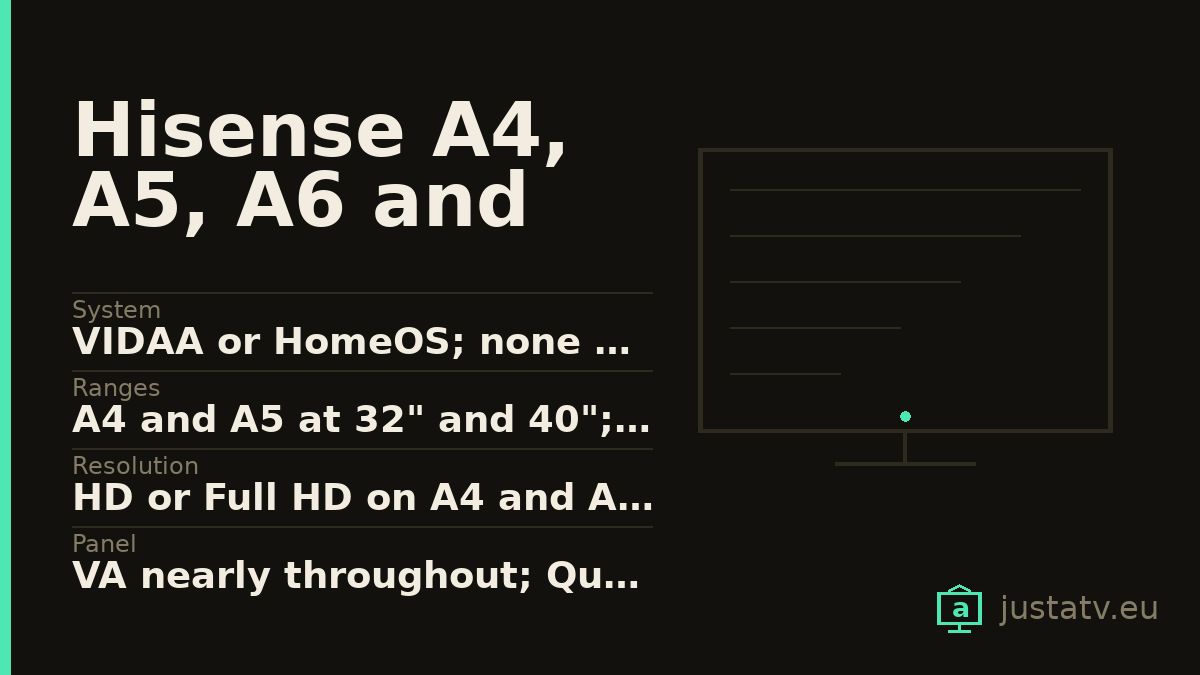
| System | VIDAA or HomeOS; none of them run Android |
|---|---|
| Ranges | A4 and A5 at 32" and 40"; A6 and A7 from 43" to 85" |
| Resolution | HD or Full HD on A4 and A5; 4K on A6 and A7 |
| Panel | VA nearly throughout; Quantum Dot only on A5 and A7 |
| Refresh rate | 60 Hz across all four ranges, no exceptions |
| Brightness | 200 nits on A4; 220-250 on A5; 200-400 on A6 and A7 |
| Dolby Vision | A6 and A7 only; the A4 and A5 do not have it |
| HDMI | 1.4 on A4 and A5; 2.1 with ALLM and VRR on A6 and A7 |
| Wi-Fi | 2.4 GHz only on A4 and A5; also 5 GHz on A6 and A7 |
| Bluetooth | Not declared on A4 or A5; 5.0 or 5.4 on A6 and A7 |
| Sound | 2 × 6-8 W on A4 and A5; 2 × 10 W on A6 and A7 |
| Memory | Hisense publishes neither RAM nor storage |
| ADB | Not available on any of them |
This is the television nobody writes about: the three-hundred-euro set that ends up in the bedroom, the holiday house or the kids' room. Hisense sells four ranges in that bracket (A4, A5, A6 and A7) and on a shop shelf they look like one product in four sizes.
They are not. Between an A5 and an A6, the size is not what changes: the kind of television does. And since almost nobody reads the spec sheet down here, it is worth putting it on the table before we talk about apps.
The four ranges are really two steps
The useful way to look at this is not A4 → A5 → A6 → A7 as a four-rung ladder. It is two pairs.
The A4 and the A5 are small sets, 32 and 40 inches, that do not reach 4K. The A6 and the A7 are 4K sets from 43 inches up, with different electronics inside.
Within each pair there is exactly one difference: the A5 is the A4 with a quantum dot panel, and the A7 is the A6 with a quantum dot panel. That is all. Same resolution, same processor, same ports.
So the real question is not "A5 or A6?" but "do I need 4K?". Everything else follows from that answer.
Where the A4 and the A5 stop
Start with the part that surprises people. The 32A4S declares "FHD TV" as its television type and, three lines further down, HD 1366x768 as its maximum resolution. Both cannot be true. The 40A4S does declare Full HD 1920x1080, and so do both sizes of the A5.
In other words: if you buy a 32-inch A4, you are most likely getting an HD panel, not a Full HD one, whatever the label says. At 32 inches it shows less than at 40, but that is the situation.
What else the two small ranges share:
- 60 Hz, with no motion interpolation.
- No Dolby Vision and no HDR10+. The A4S and the A5 declare HDR10 and HLG; the A4Q says "No" even to HDR10.
- No 4K upscaling, because there is no 4K to scale. NT72690 processor.
- HDMI 1.4, with eARC on one of the ports.
- 2.4 GHz Wi-Fi only (802.11 b/g/n). There is no 5 GHz band.
- No Bluetooth: the A4Q and the A5 declare a flat "No", and the A4S does not even carry the field.
The A5 brings its own thing: Quantum Dot, a declared colour space of 0.85 to 0.90 of DCI-P3 against the A4's 0.72, and slightly more brightness, 250 nits against 200. That difference you can see.
But watch the 32-inch one. The 32A5S uses an ADS panel and declares 1200:1 contrast, while the cheaper 32A4S uses VA and declares 3000:1. In a dark room, the small A4's blacks are better than the small A5's. You are trading contrast for colour.
What starts at the A6
Here there is a real jump, and it is not just the resolution:
- Genuine 4K UHD, 3840×2160, with an "AI 4K Upscaler" and MEMC.
- Dolby Vision, on top of HDR10, HLG and HDR10+ in decoding mode.
- HDMI 2.1 with ALLM and 48-60 Hz VRR, and eARC on the third port.
- 5 GHz Wi-Fi (802.11 a/b/g/n/ac) and Bluetooth 5.0 or 5.4.
- A Quad Core MT9603 processor instead of the NT72690.
- Two USB ports instead of one.
It is still an entry-level television: 60 Hz, not one 120 Hz panel across the four ranges, and no local dimming anywhere. Brightness runs from 200 nits on the 43-inch A6 to 300 on the 50, 55 and 65, and 330 or 400 on the large A6Q sizes. This is not real HDR; it is label HDR.
The A7 repeats all of that and adds the quantum dots: 0.90 of DCI-P3 against the A6's 0.75, and 350 or 400 nits instead of 300. If you watch films, it is the most honest difference among the four ranges.

The S and Q suffixes, and why they matter
Each range comes in two variants with a final letter. The Spanish catalogue carries the A4S and A4Q, the A5S and A5Q, the A6S and A6Q, the A7S and A7Q.
These are different generations, not different trim levels, and it shows in the system: the S models declare HomeOS U9 (A4S, A5S) or HomeOS U9.5 (A6S, and the 50, 55 and 65-inch A7S), while the Q models declare VIDAA U8.5 or VIDAA U9. It is the same system under two labels, as covered in the VIDAA cleanup guide.
There are exceptions worth checking before you buy: the 43A7S declares VIDAA U9 and Bluetooth 5.0, while its 50, 55 and 65-inch siblings declare HomeOS U9.5 and Bluetooth 5.4. And the A4Q's bullet points advertise "VIDAA U6" when its own table says VIDAA U8.5.
The sound, with one clear exception
It is 2 × 10 W almost throughout on the A6 and A7, with Dolby MS12 and DTS X, and between 2 × 6 W and 2 × 8 W on the A4 and A5.
The exception is the A7Q, the only one of the four ranges that declares 2 × 10 W plus a 20 W built-in subwoofer and the only one whose spec field says "Dolby Atmos: Yes". On the A6Q that same field says "No", and on the S models it does not appear at all: Atmos is only mentioned in the marketing copy.
What Hisense does not publish, and it hurts more here
Neither RAM nor storage. They appear in none of the twenty-six spec sheets for these four ranges. Not one figure.
On a high-end television that is annoying. Down here it is what decides how many years the set lasts: when storage fills up, apps stop updating, and eventually the television cannot even install its own system update.
And there is an aggravating factor. On an Android TV you find this out with
df -h /data in thirty seconds. On VIDAA there is no ADB, so there is no
command, no shell and no way to look. You find out the day the memory runs
out.
Other gaps we found: the A5Q has its entire connectivity table set to zero (HDMI, USB, audio outputs, all of it) and its game latency reads "TBD". Peak brightness is declared in none of the four ranges.
What can be cleaned off
Not much, and by another route. None of these ranges runs Android: they all
say VIDAA or HomeOS, which means no ADB, no pm disable and no sideloading.
We went through all 145 sheets in the Spanish Hisense catalogue and there is
not a single Google TV.
What you can do (switch off content recognition, cut personalised advertising, remove the apps the system lets you remove and skip linking an account) is set out step by step in the VIDAA guide. It applies equally to all four ranges.
If you are still choosing
For a bedroom, a 32-inch A4 does its job, as long as you accept that it is probably HD.
If the set is going in a small living room and a console is coming with it, stepping up to the A6 is not a luxury: HDMI 2.1 with ALLM and VRR, Bluetooth and 5 GHz Wi-Fi only exist from there up.
And if the budget stretches, the A7 is the A6 with better colour for a little more. What you will not find in any of the four is a 120 Hz panel, local dimming or a published memory figure.